
Traditional instructional design starts with what needs to be taught. Learning experience design starts with what the learner needs to do differently after the training. The shift sounds small. In practice it is the difference between a completed course no one applies and a training that moves a business metric.
This guide explains what learning experience design is, how it differs from instructional design, the six principles that define it, and how L&D teams in India are using it to move beyond completion rates as their only KPI.
What is learning experience design?
Learning experience design is the discipline of designing end-to-end learning journeys that produce a specific behavioural outcome. It looks at the whole experience: how learners find the training, what they do inside it, how they apply it back at work, and how they get reinforcement over time.
LxD borrows from three fields. User experience design contributes the focus on usability, flow, and delight. Behavioural science contributes triggers, habits, and spaced reinforcement, the same territory covered by learning motivation research. Instructional design contributes learning objectives, assessment, and cognitive-load principles. Together they produce learning that people actually finish and use, rather than tolerate.
The output of LxD is not a course. It is a journey map. That map may include a short microlearning module, a manager conversation, a job aid, a peer discussion, and a follow-up nudge two weeks later. The learning happens across all of them, not only in the course itself.
How is LxD different from instructional design?
Instructional design (ID) and LxD overlap heavily. Both aim to help people learn. Both use models and structured processes. The difference is scope and starting point.
- Starting point. ID starts with the content that needs to be taught. LxD starts with the learner and the behaviour to change.
- Scope. ID focuses on the course. LxD covers the whole journey, before, during, and after the course.
- Design metaphor. ID treats the learner as a student. LxD treats the learner as a user of a product.
- Success metric. ID tracks completion and pass rate. LxD tracks behaviour change and business impact.
- Toolset. ID uses ADDIE, SAM, and Bloom’s taxonomy. LxD adds journey mapping, personas, prototyping, and A/B testing.
Neither replaces the other. Most modern L&D teams use ID inside their LxD process. The instructional design work sits inside a larger experience map, the same way a single well-built module sits inside a broader role-based learning path.
What are the six principles of learning experience design?
Learner-centred, not content-centred. Every design decision starts from the learner’s context: their role, their workflow, their available time, their prior knowledge. The subject-matter expert’s preferences come second.
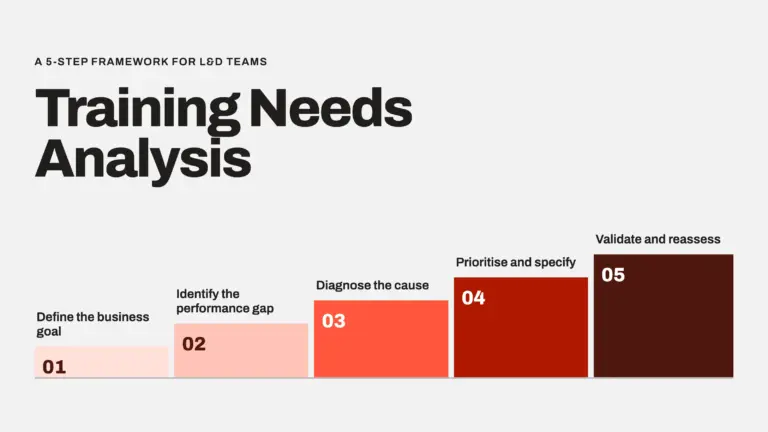
Outcome-first. Before any content is written, the team defines the behaviour or business outcome the training must produce. If the outcome cannot be described, the training should not be built. This is essentially training needs analysis applied at the design-brief stage, not left as an afterthought.
Journey, not event. Learning is designed as a sequence of touchpoints over days or weeks, not a single course of one to two hours. Spaced reinforcement is built in from the start.
Blended by default. LxD assumes learning happens across formats: video, practice, peer conversation, coaching, job aids. See our full blended learning guide for the design patterns behind this.
Measured on behaviour, not completion. Success is defined by whether the learner does something differently at work, not whether they clicked through the module. Kirkpatrick Level 3 replaces Level 1 as the primary KPI, a shift we cover in detail in our guide to the Kirkpatrick Model.
Iteratively improved. LxD treats every programme as a product. It is measured, iterated, and re-released. There is no such thing as a finished training, only a current version.
What does the LxD process look like?
Most LxD teams follow five phases: discover, define, design, deliver, and refine. The vocabulary comes from design thinking; the substance is L&D.
Discover. Talk to real learners. Shadow them at work. Understand what stops them from doing the target behaviour today. This step often reveals that the problem is not a training gap at all, it is a process, tool, or manager gap that no course will fix.
Define. Write the behavioural outcome, the target learner persona, the success metric, and the constraints. This becomes the design brief the rest of the team works to.
Design. Map the full journey: pre-work, learning experiences, application steps, reinforcement, manager touchpoints. Prototype the key modules and get real learners to try them before full build.
Deliver. Launch through the LMS. Use role-based learning paths to automate assignment and sequence. Track completion, engagement, and early behavioural signals through learning analytics, not just a completion dashboard.
Refine. Measure against the outcome. Interview learners after 30 and 90 days. Iterate the weakest modules. Retire what does not work, even if someone spent a long time building it.
What tools support learning experience design?
An LxD-friendly learning management system is the foundation. Look for role-based paths, mobile learning, xAPI support for cross-experience tracking, and analytics that go beyond completion. Our full guide to xAPI covers why tracking experiences outside the LMS matters for exactly this kind of journey design. AlphaLearn LMS was built with these capabilities as defaults, not as an add-on.
Journey-mapping tools. Miro, FigJam, or even a whiteboard are used to map learner journeys before build. The visual view forces the team to plan the whole experience, not only the course.
Authoring tools. Modern authoring platforms such as Articulate 360, Rise, and iSpring produce responsive, mobile-first content that LxD teams can iterate quickly, and most integrate cleanly with SCORM-compliant LMS platforms.
Behavioural nudge tools. Email sequences, WhatsApp reminders, and LMS notifications are used to reinforce learning at spaced intervals after the main event. Nudges are as important as the course itself, and often cheaper to get right.
What are common LxD pitfalls to avoid?
Starting with content instead of learners. The most common mistake is jumping to storyboards before interviewing anyone who will actually use the training. Two learner interviews at the start save weeks of rework later.
Treating LxD as a re-branding. Calling instructional designers “learning experience designers” without changing the process, metrics, or scope produces no results. The shift has to be real, not cosmetic, or the org chart just gets a new job title.
Skipping measurement. If the outcome is not measured, the improvement loop breaks. Even a simple manager survey four weeks after launch is better than nothing.
Under-investing in reinforcement. Most L&D budgets go into the main event. LxD budgets shift 30 to 40% of spend to what happens after the event. That is where behaviour actually changes, not in the live session itself.
How do you start with LxD in your organisation?
Pick one high-visibility programme. Do not try to rework every training at once. Pick one, usually onboarding, sales enablement, or a compliance refresher, and redesign it using the LxD process end to end. Prove the model before scaling it across the L&D function.
Involve business stakeholders. LxD needs a defined business outcome. That requires a sponsor from the business who will commit to a metric. If no one on the business side will name a KPI, the redesign is not worth doing yet.
Choose an LMS that supports the model. Legacy LMS platforms designed only for SCORM course delivery limit what LxD can do. See how AlphaLearn’s LMS features support blended journeys, explore the Enterprise LMS page for large-scale rollout, or start a free trial to build your first LxD journey in one week.
Key takeaways
- Learning experience design starts from the learner and the desired behaviour, not from the content that needs to be taught.
- The output of LxD is a journey map across multiple touchpoints, not a single course.
- Instructional design still matters; it sits inside a larger LxD process rather than being replaced by it.
- The six principles are learner-centred, outcome-first, journey not event, blended by default, measured on behaviour, and iteratively improved.
- Start small: pick one high-visibility programme, secure a business sponsor with a real metric, and prove the model before scaling.
Ready to design a learning journey people actually apply? Book a demo of AlphaLearn, or start a free 14-day trial.
Frequently asked questions
What is learning experience design?
Learning experience design (LxD) is the practice of designing end-to-end learning journeys around the learner’s context, goals, and desired outcomes rather than around content delivery. It borrows from user experience design, behavioural science, and instructional design.
How is LxD different from instructional design?
Instructional design starts with the content to teach and focuses on the course. Learning experience design starts with the learner and the behaviour to change, and covers the full journey before, during, and after training. Neither replaces the other; instructional design often sits inside an LxD process.
What are the six principles of learning experience design?
The six LxD principles are: learner-centred not content-centred, outcome-first, journey not event, blended by default, measured on behaviour not completion, and iteratively improved as a product rather than delivered as a finished course.
What is the LxD process?
Most LxD teams follow five phases: Discover (talk to learners), Define (write the outcome and persona), Design (map the journey and prototype), Deliver (launch via the LMS), and Refine (measure behaviour change and iterate).
What tools support learning experience design?
An LxD-friendly LMS with role-based paths, mobile learning, and xAPI support forms the foundation. Journey-mapping tools like Miro, authoring tools like Articulate 360, and behavioural nudge tools using email and WhatsApp reinforcement complete the stack.
How do I start with LxD in my organisation?
Pick one high-visibility programme like onboarding or sales enablement and redesign it end to end using the LxD process. Involve a business stakeholder who will commit to a measurable outcome. Choose an LMS that supports blended journeys rather than only SCORM courses.
Is LxD only relevant for large L&D teams with dedicated designers?
No. The principles scale down as easily as they scale up. A single-person L&D team can apply outcome-first thinking and spaced reinforcement to one onboarding programme without hiring a dedicated learning experience designer. What matters is the shift in process and measurement, not the size of the team applying it.
Neha Iyer
Learning Experience Designer
Neha specialises in eLearning design, blended learning models, and learner engagement strategy. She brings a learner-first perspective to instructional design, with a focus on mobile-first delivery for deskless workforces.
Get Started
See AlphaLearn in action
500,000+ employees trained. ISO 27001:2022 certified.