Every effective corporate training course sits on top of an instructional design model. Whether the L&D team knows it or not, they are using one. The three most influential – ADDIE, SAM, and Bloom’s Taxonomy – have shaped how training gets built across industries worldwide. This guide explains what each one is, when to use it, and how to apply it inside a modern LMS.
What are instructional design models?
Instructional design models are structured frameworks that guide how a training programme is planned, built, delivered, and evaluated. They exist so L&D teams do not have to reinvent the process for every new course.
Most models share three ideas. Start with what the learner needs to achieve. Design content and activities that build toward it. Measure whether the training worked. What differs is sequence, speed, and philosophy.
Models are tools, not rules. Experienced designers use them as scaffolding, not scripts. In practice most enterprises combine two – often ADDIE or SAM for process, with Bloom’s Taxonomy for objective writing. All three integrate cleanly into a modern learning management system.
What is the ADDIE model?
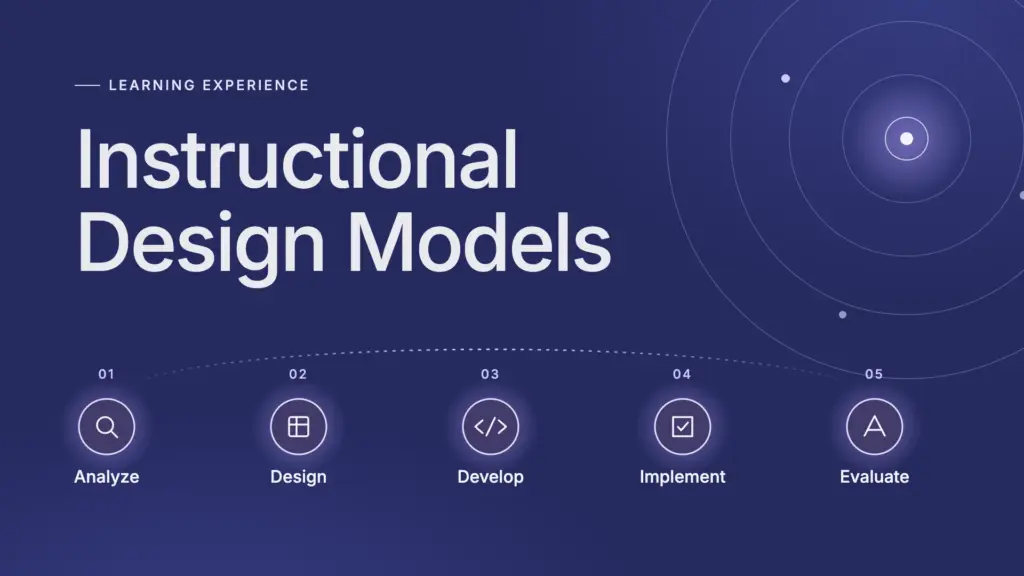
ADDIE is the most widely used instructional design model. The name is an acronym for its five phases: Analyse, Design, Develop, Implement, Evaluate. Each phase feeds the next.
- Analyse. Identify who the learners are, what they need to learn, and what business outcome the training will support. This overlaps with training needs analysis.
- Design. Write learning objectives, choose delivery methods (video, quiz, workshop), sequence the modules, and plan assessments.
- Develop. Build the content – scripts, videos, quizzes, job aids, facilitator notes.
- Implement. Launch the training through the LMS or classroom, enrol learners, and manage delivery.
- Evaluate. Measure whether learners achieved the objectives and whether the business outcome improved.
ADDIE works best when content is stable, compliance auditors want a documented process, and the L&D team has time for full linear development. It struggles when content changes weekly or when speed is essential.
What is the SAM model?
SAM (Successive Approximation Model) was developed by instructional designer Michael Allen as a faster, agile alternative to ADDIE. Instead of five linear phases, SAM uses short iterative cycles that produce a working prototype early.
SAM has three phases. Preparation collects background information and objectives in an initial working session. Iterative design produces sketches, prototypes, and reviews in short loops. Iterative development builds, tests, and refines the actual training in similar short cycles.
The key difference from ADDIE is that SAM assumes the first design will be wrong and builds in cycles to fix it. This matches how modern software is built and how learners actually respond to training. It works well for fast-changing content, product training, and sales enablement.
SAM is not always right. For heavily regulated compliance training in BFSI, pharma, or healthcare, the auditability of ADDIE’s documented linear process often outweighs SAM’s speed. Choose the model that fits the risk profile.
What is Bloom’s Taxonomy?
Bloom’s Taxonomy is a framework for classifying the depth of learning objectives. It answers the question: what level of thinking should the learner reach after this training? Benjamin Bloom developed it in 1956; a 2001 revision led by Lorin Anderson and David Krathwohl updated the category names from nouns to verbs and reordered the top two levels.
The revised taxonomy has six levels, ordered from lowest to highest cognitive depth.
- Remember. Recall facts and basic concepts. Example: list the rights a data principal has under the DPDP Act.
- Understand. Explain ideas or concepts. Example: describe why POSH training is conducted annually.
- Apply. Use information in new situations. Example: fill in a KYC form for a walk-in customer.
- Analyse. Draw connections among ideas. Example: identify why a phishing email is a phishing email.
- Evaluate. Justify a stand or decision. Example: recommend whether to approve a loan application.
- Create. Produce new or original work. Example: design a compliance training plan for a new branch.
The taxonomy is used to write objectives. A well-formed objective uses a verb from the target Bloom’s level: “Analyse three customer scenarios and recommend the correct KYC action.” The verb signals the depth of assessment required.
Which instructional design model should you use?
Choose ADDIE when content is stable and reused for years, compliance and audit trails matter, the project has clear phases and a fixed budget, and the team is new to instructional design and needs structure.
Choose SAM when content changes frequently, the business needs to see something working in weeks not months, learners’ feedback should shape the design, and the team can handle iterative reviews.
Use Bloom’s Taxonomy always. It is not a competing model but a tool that improves objective writing inside any process. Whether you use ADDIE, SAM, or learning experience design, Bloom’s makes your objectives sharper.
Most large L&D teams use ADDIE for regulated compliance content, SAM for sales and product content, and Bloom’s Taxonomy across both. There is no single right answer – the right combination depends on the content type, the audit requirement, and the pace of change.
How do you apply these models in an LMS?
Use the Analyse phase to define who gets which training. In AlphaLearn, this becomes a role-based learning path – the system auto-assigns the right content to the right role.
Use the Design phase to plan the module sequence, quiz weightings, and pass thresholds. AlphaLearn’s course builder supports pre-tests, module gating, and branching based on assessment results.
Use the Evaluate phase with LMS analytics. Modern learning analytics dashboards show completion, score, time-on-task, and correlate with business outcomes when integrated with HRMS or CRM data.
What are common mistakes with instructional design models?
Following a model without questioning it. ADDIE and SAM are guides, not laws. Skipping analysis to start building is a mistake; so is spending six months in analysis for a two-week piece of training.
Writing objectives at the wrong Bloom’s level. A compliance module often needs “Apply” or “Analyse” but ends up assessed only at “Remember.” That produces learners who pass the quiz and still get the process wrong.
Skipping evaluation. Both ADDIE and SAM end with evaluation. In practice most L&D teams stop after launch because there is a new project to start. This is why so many training programmes have no evidence of impact.
Instructional Design Models – Frequently Asked Questions
Q: What are instructional design models?
A: Instructional design models are structured frameworks that guide how a training programme is planned, built, delivered, and evaluated. The most widely used are ADDIE, SAM, and Bloom’s Taxonomy.
Q: What is the ADDIE model?
A: ADDIE is a five-phase instructional design model standing for Analyse, Design, Develop, Implement, and Evaluate. It is the most widely used process for building corporate training courses and works well for stable content and regulated environments.
Q: What is the SAM model?
A: SAM (Successive Approximation Model) is an agile alternative to ADDIE developed by Michael Allen. It uses short iterative cycles that produce a working prototype early and is best for fast-changing content like product training and sales enablement.
Q: What is Bloom’s Taxonomy?
A: Bloom’s Taxonomy is a framework for classifying the depth of learning objectives. The revised 2001 version has six levels from lowest to highest cognitive depth: Remember, Understand, Apply, Analyse, Evaluate, and Create.
Q: Which instructional design model is best?
A: There is no single best model. Choose ADDIE for stable, regulated content that needs an audit trail. Choose SAM for fast-changing content that benefits from iteration. Use Bloom’s Taxonomy alongside either to write sharper learning objectives.
Q: How do instructional design models work with an LMS?
A: The Analyse phase maps to role-based learning paths in the LMS. The Design phase maps to course structure, quiz weightings, and pass thresholds. The Evaluate phase maps to LMS analytics dashboards that measure completion, scores, and business outcome correlation.
Rohit Desai
Compliance & Training Manager
Rohit has led compliance training programmes in pharma, manufacturing, and healthcare for over a decade. He writes about POSH, GMP, safety regulations, and building audit-ready training records on an LMS.
Get Started
See AlphaLearn in action
500,000+ employees trained. ISO 27001:2022 certified.