
Learning motivation is the single biggest predictor of whether corporate training actually works. You can invest in the best content, the best platform, and the most thorough curriculum – and still see low completion rates and poor knowledge retention if learners are not motivated to engage. This article covers nine evidence-based strategies that L&D teams in Indian enterprises use to build and sustain learning motivation across their workforce.
1. Connect every module to a career outcome employees actually care about
The most common reason employees skip or skim training is that they cannot see why it matters to them personally. “Complete the compliance module” lands differently than “This certification is required before you can be considered for the senior associate role.” Before publishing any training, L&D teams should answer one question: what does completing this unlock for the learner?
In practice, this means linking training to role-based competency frameworks – so that every employee can see exactly which courses bring them closer to their next performance review milestone, promotion eligibility, or skill badge. AlphaLearn’s personalised learning paths surface this context within the learner’s dashboard, making the career connection visible, not just implied.
2. Use gamification to make completion rewarding in itself
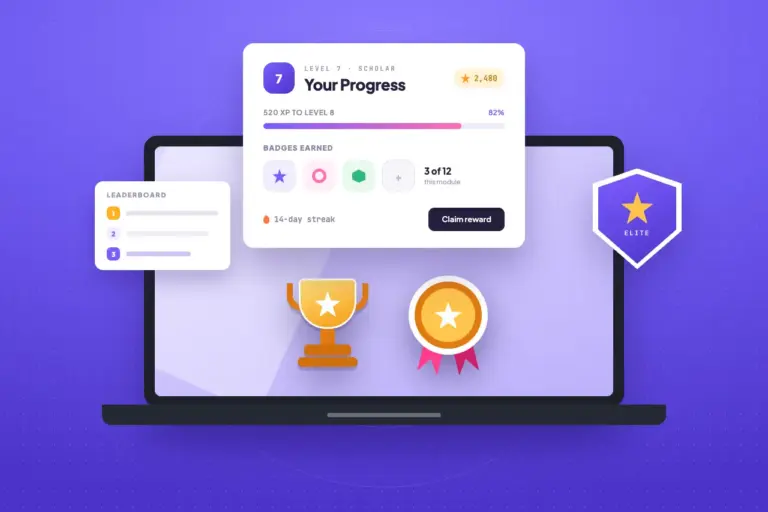
Gamification activates the brain’s reward circuitry – the same mechanism that makes games compelling. When employees earn points for completing modules, receive badges for reaching milestones, and see their name on a department leaderboard, extrinsic motivation reinforces the habit of learning. Over time, the habit becomes intrinsic.
Effective gamification for corporate training includes:
- Points: awarded for completing courses, watching videos, passing assessments, and daily logins
- Badges: milestone badges (e.g., “POSH Compliance Certified 2026”) that employees can share on internal profiles
- Leaderboards: department, branch, and company-wide leaderboards that create healthy competition
- Streaks: daily learning streaks that encourage consistent short-session habits
- Digital certificates: auto-generated on completion – a powerful signal of achievement that employees keep
Organisations using gamified LMS platforms consistently report 40-60% higher course completion rates than non-gamified equivalents.
3. Cut modules down to microlearning size
One of the most reliable killers of learning motivation is a 45-minute e-learning module that could have been a 5-minute video. Long, dense modules create cognitive overload and compete with every other priority in a working day. Microlearning – modules of 3 to 8 minutes – removes the friction of starting, which is usually the biggest barrier.
This is especially important for frontline and blue-collar employees who access training on mobile during breaks or shift transitions. A 6-minute product refresher they can complete between customer interactions is infinitely more effective than a 30-minute desktop module they defer indefinitely. The rule of thumb: if a module covers more than one learning objective, split it.
4. Personalise learning paths based on role and skill gap
Generic training catalogues demotivate learners because they require effort to navigate and rarely feel relevant. An IT engineer forced to complete retail SOP training, or a sales manager assigned content written for new graduates, will disengage quickly – and with justification.
AI-powered skill gap analysis closes this gap. By assessing each employee’s current competency against their role requirements, an LMS can auto-assign only the training that is genuinely needed – and in the right sequence. AlphaLearn’s personalised path engine does this at scale: every employee sees a learning plan that reflects their actual role, level, and assessed skill gaps. Relevance is the fastest motivator.
5. Recognise achievement publicly and with verifiable credentials
Recognition is one of the most cost-effective motivators available to L&D teams, and it is chronically underused. When an employee completes a certification, the most motivating response is not a private notification – it is a visible acknowledgement that their peers and manager can see.
Best-practice approaches include: automated manager notifications on employee certification, certificate sharing features that employees can post on LinkedIn or internal intranets, branch or department rankings that make training achievement visible, and integration with performance review systems so completed certifications appear on performance records. Visible recognition creates a social norm that training completion is valued – and that norm is self-reinforcing.
6. Enable peer and social learning
Many employees are more motivated to learn from colleagues they trust than from formal content created by L&D. Social learning features – discussion forums, cohort-based learning, peer Q&A, expert mentoring threads – tap into social motivation and make training feel less isolated.
For Indian enterprises with dispersed teams, this is particularly valuable. A distributor in Pune who can ask a question in a shared discussion thread and receive an answer from a senior colleague in Mumbai is more likely to stay engaged than one learning entirely in isolation. Peer validation and collaborative problem-solving sustain motivation that formal content alone cannot.
7. Give learners autonomy over pace and sequence
Self-Determination Theory (Deci and Ryan) identifies autonomy as one of the three core drivers of intrinsic motivation. When learners feel they have control over how and when they learn, engagement increases substantially. This means: self-paced access rather than fixed-schedule live sessions where possible, the ability to pause and resume without losing progress, choice between content formats (video, text, interactive) for the same learning objective, and flexibility to complete modules in a preferred order within a path.
Autonomy does not mean unstructured. Learning paths can have required sequences and deadlines – but within those constraints, giving learners as much control as possible over the mechanics of their learning increases motivation and reduces dropout.
8. Use real workplace scenarios instead of abstract content
Abstract, theoretical training content fails to motivate adult learners because it cannot answer the most fundamental question: “So what do I actually do differently on Monday?” Scenario-based learning – where employees work through realistic situations from their own role – is consistently more engaging and produces better knowledge transfer.
For a BFSI compliance module, this means simulating a real KYC interaction, not reciting the regulation. For a manufacturing safety module, it means a near-miss scenario on a recognisable shopfloor, not a generic safety poster. The closer the training scenario is to the learner’s actual work context, the more motivated they are to engage – because the relevance is immediate and obvious.
9. Share live progress data with managers to create accountability
Learner motivation increases significantly when employees know their manager can see their progress in real time. This is not about surveillance – it is about making training visible as a workplace expectation rather than an optional extra. When managers have access to completion dashboards, they can acknowledge progress in one-on-ones, flag employees who are falling behind early enough to intervene constructively, and connect training to performance conversations in a meaningful way.
AlphaLearn’s manager dashboards show completion rates, assessment scores, and certification status by team member – giving managers the data they need to support learning as a business priority rather than delegating it entirely to L&D.
What is learning motivation – and why does it matter in corporate training?
Learning motivation is the internal or external drive that determines whether an employee engages with training, persists through difficulty, and applies what they learn. Psychologists categorise it as intrinsic (driven by curiosity, interest, and personal growth) or extrinsic (driven by rewards, recognition, and career advancement).
In corporate training, motivation matters because completion without application is waste. An employee who completes a compliance module to avoid a reminder email has absorbed very different learning than one who completes it because they understand why compliance protects them and their organisation. The nine strategies above address both types of motivation – extrinsic mechanisms (gamification, recognition, accountability) that build the habit, and intrinsic factors (relevance, autonomy, real scenarios) that sustain it.
Frequently asked questions – learning motivation
Q: What is learning motivation?
A: Learning motivation is the internal or external drive that determines whether a person engages with training and applies what they learn. In corporate L&D, it includes intrinsic motivation (curiosity, relevance to career goals, personal growth) and extrinsic motivation (points, certificates, recognition, promotion eligibility). Both types matter – extrinsic rewards build the habit; intrinsic factors sustain it.
Q: How do you motivate employees to complete mandatory compliance training?
A: Connect it to a visible consequence, not just a deadline. Certification visible on performance records, manager notifications, and tiered access (completing POSH training unlocks other content) all create motivation beyond the compliance reminder email. Gamification – points and a team leaderboard for compliance completion – turns a chore into a completion challenge.
Q: What is the difference between intrinsic and extrinsic motivation in learning?
A: Intrinsic motivation comes from within – curiosity, enjoyment of learning, satisfaction from mastering a skill. Extrinsic motivation comes from external rewards – a certificate, a leaderboard position, a promotion, or a manager’s acknowledgement. Effective corporate training designs for both: extrinsic rewards (gamification, recognition) build the initial habit; intrinsic factors (relevant scenarios, career context) sustain long-term engagement.
Q: Does microlearning improve learning motivation?
A: Yes – primarily by removing the friction of starting. A 5-minute module is easy to begin; a 45-minute module is easy to defer. Once an employee starts a short module, completion rates are very high. Microlearning also fits naturally into fragmented workdays – frontline employees can complete a module on their phone during a break rather than needing a dedicated 45-minute window.
Q: How does gamification improve learning motivation in an LMS?
A: Gamification activates extrinsic motivation by turning training completion into a rewarding experience. Points, badges, and leaderboards create visible progress and social recognition. Streaks build daily habits. Certificates provide verifiable credentials employees want to earn. Organisations using gamified LMS platforms consistently report 40-60% higher completion rates compared to non-gamified equivalents.
Q: What LMS features directly improve learning motivation?
A: The features with the strongest impact on motivation are: personalised learning paths (relevance), gamification (reward), microlearning format support (reduced friction), manager dashboards (accountability), social and peer learning tools (community), and digital certification (recognition). AlphaLearn includes all of these in its standard platform – across 12 Indian languages for teams spread across regions and roles.
Build a motivated learning culture with AlphaLearn
AI-powered personalised paths, gamification, real-scenario assessments, and 12-language delivery. One platform to motivate every learner across every role.
Arjun Mehta
HR Technology Consultant
Arjun advises mid-size and enterprise teams on LMS selection, HR tech integration, and digital learning transformation. He has helped 40+ organisations deploy AlphaLearn across India and the Middle East.
Get Started
See AlphaLearn in action
500,000+ employees trained. ISO 27001:2022 certified.