Every year, Indian enterprises spend crores on training that no one asked for and no one applies. Ask any L&D leader who has audited their own course catalogue and you will hear the same story: half the library was built because a function head requested it, not because anyone confirmed employees actually needed it. Training needs analysis (TNA) fixes that. It is the diagnostic step that turns L&D from a budget line into a business function. This guide explains what TNA is, why it matters, and how to run one in five practical steps.
What is training needs analysis?
Training needs analysis is a structured way to answer one question before you build any course: is training the right solution, and if so, exactly which training and for whom? A TNA looks at business objectives, the tasks a job requires, and the skills a person currently has, then reports the gap between them. What remains after the analysis is a shortlist of training priorities you can defend to a CFO, not a list of everything L&D would like to build.
The framework most L&D teams use is Allison Rossett’s three-level model, first laid out in her book “Training Needs Assessment” and still the reference point cited in most corporate L&D certification programmes. Organisational analysis asks whether training aligns with strategy and where in the business a performance gap exists. Task or operational analysis breaks a job down into the specific tasks and competencies it demands, closely related to competency mapping. Person analysis compares each employee’s current performance to that standard. Together the three levels tell you what to train, whom to train, and whether training is even the right lever, because sometimes the answer is a process fix or a tooling change, not a course.
Why training needs analysis matters
Skipping the analysis is why so many training programmes fail to move a needle. ATD’s State of the Industry research has repeatedly found that organisations investing in systematic needs analysis report significantly higher training transfer rates than those that skip straight to content design. When TNA is done well, three things change:
- Budget goes to training that will be used. Mandatory-only assumptions are replaced with prioritised gaps tied to business goals.
- Completion and application rise. Employees engage with training that clearly relates to their role, not with a generic library.
- Compliance risk drops. Regulatory training gaps for POSH, DPDP, GMP, or RBI-mandated topics surface before an audit does, not after.
The opposite pattern, launching training before a needs analysis, is what produces the completion crisis most L&D leaders quietly live with: high enrolment, low finish rate, and no visible business impact.
The 5-step training needs analysis framework
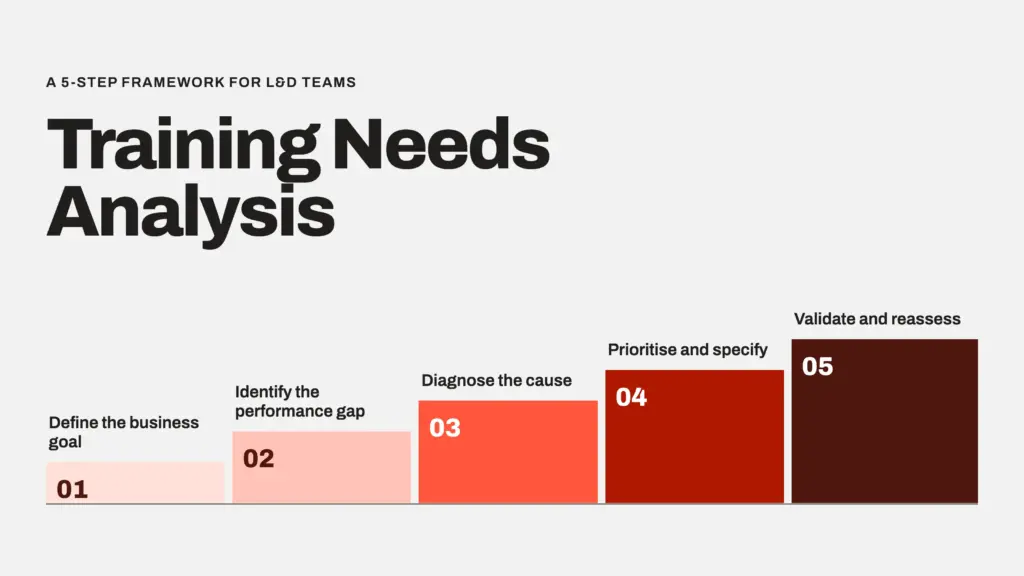
A TNA does not need a consulting engagement. Five steps, done in sequence, are enough for most enterprises.
Step 1. Define the business goal. Start with what the business wants to change: a revenue target, a quality metric, a compliance obligation, a churn number. The goal frames the entire analysis. Without it, TNA becomes a wish-list exercise dressed up as data.
Step 2. Identify the performance gap. Look at the numbers that show where the goal is not yet being met. Sales quota attainment, first-time-right rates, audit findings, safety incidents, mystery-shopper scores, average handle time. A gap that shows up in the data is a gap worth investigating; one that only shows up in opinion may not be.
Step 3. Diagnose the cause. Not every performance gap is a training gap. Ask, for each gap, whether people can do the task correctly if their lives depended on it. If yes, the problem is motivation, process, tools, or incentives, and training will not fix it. If no, you have a genuine skill or knowledge gap that training can close.
Step 4. Prioritise and specify. Rank the confirmed training gaps by business impact, size of the affected population, and regulatory risk. For each priority, specify the target audience, the required competencies, the delivery method, and how you will measure success. This becomes the brief for content design, whether that is a full role-based learning path or a single refresher module.
Step 5. Validate and reassess. Share the shortlist with the sponsoring business leader before build. After roll-out, use LMS data such as completion, assessment scores, and on-the-job application to check that the gap actually closed. Then re-run the TNA at least annually, and whenever the business or regulatory environment changes.
Where the data comes from
A defensible TNA draws on multiple data sources so no single view dominates. Most Indian enterprises use a mix of the following.
| Source | What it tells you | How to use it |
|---|---|---|
| HRIS and performance reviews | Role, tenure, ratings, promotion history | Segment gaps by role and level |
| Business KPIs and dashboards | Sales, quality, safety, service metrics | Anchor gaps to numbers a leader already tracks |
| LMS reports | Completion, scores, time-to-competency | Identify weak modules and repeat failures |
| Manager surveys and interviews | On-the-job observations, upcoming role changes | Surface tacit gaps not visible in reports |
| Employee self-assessments | Confidence, perceived barriers, interests | Cross-check manager view; find hidden strengths |
| Regulatory and audit findings | POSH, DPDP, GMP, RBI, ISO, NABH gaps | Non-negotiable training priorities |
AlphaLearn’s learning analytics covers the LMS-reports row directly, surfacing weak modules, repeat assessment failures, and time-to-competency by role without a manual export.
A simple training needs analysis template
For each gap, capture the following fields in a single row. A spreadsheet is enough to start; a dedicated LMS makes it easier to keep the analysis and the delivery in one place instead of two disconnected systems.
- Business goal it supports (with the metric)
- Performance gap in numbers (current vs target)
- Root cause (skill, knowledge, attitude, tool, process)
- Target audience (role, department, location, count)
- Required competency or learning outcome
- Proposed delivery method (self-paced, ILT, VILT, OJT, blended)
- Priority (high, medium, low) and rationale
- Success measure and review date
TNA vs training gap analysis vs learning needs assessment
These three terms are used almost interchangeably in Indian L&D teams. The differences are small but useful to know.
| Term | Scope | When to use it |
|---|---|---|
| Training needs analysis (TNA) | Full three-level diagnosis: organisation, job, person | Annual planning, new function launch, major reorganisation |
| Training gap analysis | Focused comparison of current vs required skills for a role or team | Reskilling, promotions, role redesign |
| Learning needs assessment | Broader than training, includes coaching, mentoring, on-the-job support | When training may not be the only or best answer |
Common mistakes to avoid
- Confirming training you already planned to run. TNA that never rejects any programme is not analysis, it is decoration.
- Treating every performance gap as a training gap. Some gaps need a policy change, a tool upgrade, or a manager conversation instead.
- Skipping the business leader. An L&D-only TNA reads as opinion. Involve the function that owns the metric.
- Analysing once and never again. Roles evolve, regulations update, and last year’s TNA is quickly out of date.
- Confusing preference with need. Employees may want a leadership course; the business may need product training first.
How AlphaLearn supports training needs analysis
AlphaLearn brings the diagnostic and the delivery under one roof. Skill libraries and competency mapping let you define the required standard for each role, engagement and assessment reports show where employees currently sit against it, and role-based automation assigns the right training the moment a gap is confirmed. Certification management keeps regulated competencies such as GMP and safety training current with automatic renewal, and compliance tracking for POSH, DPDP, GMP, RBI, and NABH obligations makes regulatory gaps visible before an auditor finds them.
Learn more on the features page, the Enterprise LMS page, or the compliance training solution. If your TNA points to skill gaps rather than compliance gaps, see how skills-based learning reorganises training around what people can actually do.
Key takeaways
- Training needs analysis is the diagnostic step that decides what to train, whom to train, and whether training is even the right answer.
- Use Rossett’s three levels: organisation, job, and person, each answering a different question.
- A five-step framework, defining the goal, identifying the gap, diagnosing the cause, prioritising, and validating, is enough for most enterprises.
- Not every performance gap is a training gap; test each one before adding it to the training calendar.
- Re-run TNA at least annually, and whenever the business or regulatory environment changes.
Ready to build a training programme grounded in real needs, not assumptions? Book a demo of AlphaLearn, or start a free 14-day trial.
Frequently asked questions
What is training needs analysis?
Training needs analysis is a structured process to identify the gap between the skills, knowledge, and behaviours employees currently have and what the business needs them to have. It is used to decide which training will produce a measurable business result, and which requests should be declined because training is not the right fix.
What are the three levels of training needs analysis?
The three-level TNA model, developed by Allison Rossett, examines the organisation, the job, and the person. Organisational analysis links training to business strategy and identifies where a performance issue exists. Task or job analysis breaks a role down into its required tasks and competencies. Person analysis compares each employee’s current capability to that standard.
How do you conduct a training needs analysis?
Follow five steps. Define the business goal, identify the performance gap using data, diagnose whether the cause is skill or something else, prioritise the confirmed training needs by impact and risk, and validate the shortlist with the business leader. After roll-out, use LMS reports to check that the gap actually closed.
Is training needs analysis the same as training gap analysis?
They overlap but differ in scope. TNA is a full three-level diagnostic covering organisation, job, and person. Training gap analysis is narrower, comparing current versus required skills for a specific role or team. A learning needs assessment is broader still and can recommend coaching, mentoring, or job aids in place of formal training.
How often should a training needs analysis be done?
At least once a year, ideally as part of L&D planning. Run an additional TNA whenever a major business change happens, such as a reorganisation, a new product launch, or a regulatory update, or when performance data suggests the previous analysis is out of date.
Can an LMS help run a training needs analysis, or is it only for delivery?
A modern LMS supports both. Skill libraries and competency mapping define the required standard per role, assessment and engagement reports show current performance against that standard, and reporting dashboards surface weak modules and repeat failures without a manual data pull. Keeping the analysis and the delivery in one platform also makes Step 5, validating that a gap actually closed, far easier than reconciling a TNA spreadsheet against a separate LMS export.
Rohit Desai
Compliance & Training Manager
Rohit has led compliance training programmes in pharma, manufacturing, and healthcare for over a decade. He writes about POSH, GMP, safety regulations, and building audit-ready training records on an LMS.
Get Started
See AlphaLearn in action
500,000+ employees trained. ISO 27001:2022 certified.