Most L&D dashboards report the wrong number. Completion rate is a hygiene metric, not a business one – it tells you employees clicked next, not that anything changed. The Kirkpatrick Model, first published by Donald Kirkpatrick in 1959 and still the most widely cited training evaluation framework in corporate L&D, forces the harder question: did behaviour shift and did the business benefit?
A 2023 survey by the Kirkpatrick Partners found that 65% of L&D teams measure only Level 1 (reaction) and Level 2 (learning) data. Fewer than 15% regularly measure Level 3 (behaviour). Level 4 (results) – where training proves its value to a CFO – is measured consistently by fewer than 8% of teams, according to Brandon Hall Group research. The model has been available for over six decades. The measurement gap is not a knowledge problem. It is a tooling and prioritisation problem that a modern LMS can fix.
Who was Donald Kirkpatrick and why does the model still matter?
Donald Kirkpatrick was an American professor and president of the American Society for Training and Development (now ATD) who introduced his four levels of training evaluation in a series of articles in 1959. He expanded them into a definitive book, “Evaluating Training Programs: The Four Levels,” in 1994. His son Jim Kirkpatrick and daughter-in-law Wendy Kayser Kirkpatrick later refined the framework into the New World Kirkpatrick Model, adding required drivers – reinforcement, encouragement, rewards, and monitoring – as the conditions that make behavioural transfer possible between Levels 2 and 3.
Six decades on, the four-level structure remains the default vocabulary L&D teams use with CFOs, CHROs, and business sponsors. It maps cleanly onto the sequence in which training actually produces value, and it provides a shared language that a finance team or operations head can engage with without an L&D background. No competing framework has displaced it as a common standard. ISO 10015:2019, the international standard for quality management guidelines for training, is compatible with the Kirkpatrick framework and is used by Indian enterprises seeking to align L&D with quality management systems.
The Kirkpatrick four levels, explained
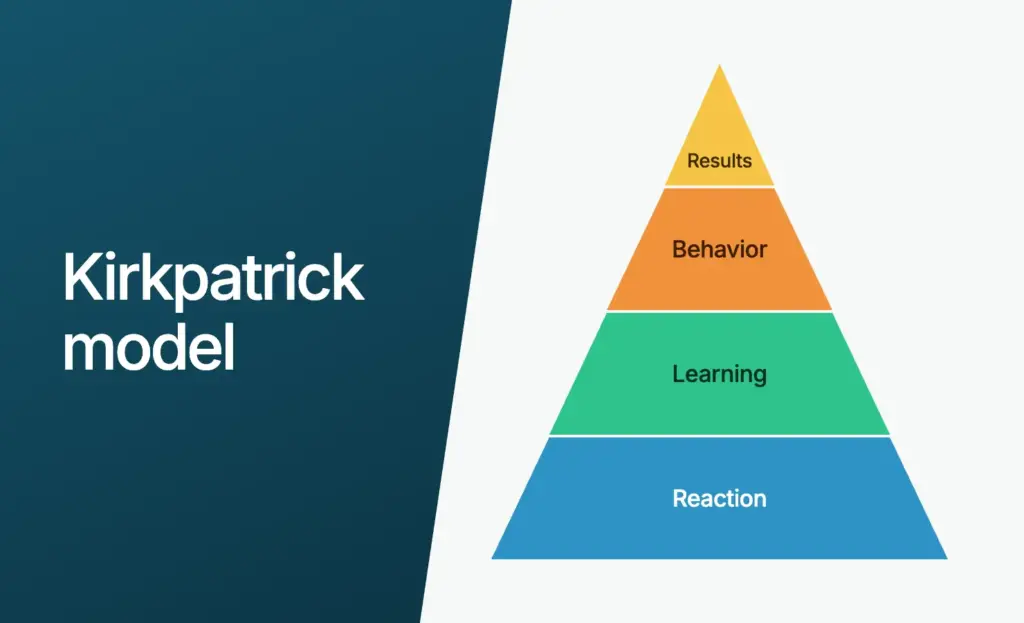
Each level answers a different question and demands a different measurement method. The levels are cumulative but not substitutable. A positive reaction does not prove learning. Learning does not prove application. Application does not prove business impact. An L&D team reporting only Level 1 or 2 data has, from a CFO’s perspective, reported almost nothing about whether the investment worked.
| Level | Question it answers | What it measures | When to measure |
|---|---|---|---|
| 1. Reaction | Did learners find the training relevant and engaging? | Satisfaction, perceived usefulness, likelihood to apply | Immediately after the course |
| 2. Learning | Did they acquire the intended knowledge or skill? | Assessment scores, pre-post delta, pass rate, confidence | During and at the end of the course |
| 3. Behaviour | Are they applying it on the job? | Manager observation, follow-up assessments, sample checks | 30-90 days after the course |
| 4. Results | Did the business outcome move? | KPIs the training was designed to influence | 60 days to 12 months after roll-out |
Level 1: Reaction
Level 1 checks whether learners found the training relevant, engaging, and useful. It is the easiest and cheapest measurement to collect, which is why it is the most over-used – and the most over-interpreted. A 4.2 out of 5 on a post-course smile sheet tells you learners were not actively miserable. It does not tell you they will behave differently on Monday.
Modern practice moves beyond the smile sheet. Kirkpatrick Partners distinguish between two types of reaction: satisfaction (did they like it) and engagement (did they feel involved and motivated). A well-designed Level 1 survey asks targeted questions: Was the content relevant to your current role? Will you apply what you learned in the next 30 days? What one thing would you change? Include a short in-course pulse check – a single question mid-module – so you catch disengagement before the course ends rather than after. Scores below a defined threshold should trigger a content review, not a celebration of 85% completion.
In Indian enterprise training – where many programmes are mandatory (POSH Act, GMP, fire safety, RBI compliance) – Level 1 data is particularly useful for identifying content that feels irrelevant to the learner’s actual job. Low relevance scores on mandatory training are a design signal, not an attitude problem.
Level 2: Learning
Level 2 confirms that the intended knowledge, skill, or attitude was actually acquired. Assessment scores are the primary measure, but the post-assessment score alone is far less informative than the delta between pre and post. A learner who scores 80% after a course could have scored 75% before it, meaning the training added 5 percentage points of knowledge. Or they could have scored 30% before it, meaning the training genuinely worked. The score without the delta misses that distinction entirely.
For skills-based training – sales techniques, GMP handling procedures, clinical protocols – add a scenario-based or practical assessment that requires the learner to demonstrate the skill, not just select the correct multiple-choice option. Recognition and recall are different cognitive operations. A GMP-trained technician who can pass a quiz but cannot correctly sequence a cleanroom entry procedure in a simulation has completed Level 2 on paper but not in practice.
In a modern LMS platform, pre-assessment, post-assessment, scenario scoring, and pass-rate reporting by course, cohort, and role are all captured automatically and available in real-time dashboards. There is no spreadsheet required.
Level 3: Behaviour
Level 3 is where most L&D teams stop measuring, because it requires work beyond the LMS. Behavioural transfer happens 30 to 90 days after the training, involves the line manager, and is only partial even in the best-designed programmes. The New World Kirkpatrick Model identifies required drivers – reinforcement activities, encouragement from managers, performance support tools, and monitoring – as the conditions that make transfer possible. Without them, even excellent training does not stick.
Measure Level 3 with a combination of methods: manager check-ins against a short observation checklist (sent automatically by the LMS at the 30-day mark), a follow-up self-assessment by the learner at 60 days, a scenario-based reassessment inside the LMS at 90 days, and where operationally feasible, a workplace observation or sample check by a subject-matter expert. Do not report 100% transfer as a target – it does not happen. Report the proportion of employees demonstrating the target behaviour at 90 days, compared to baseline.
For Indian enterprise training programmes, Level 3 measurement has specific value in compliance contexts: a POSH awareness programme should show that employees handle complaints through the correct channel, not just that they passed the quiz. A GMP refresher should show that non-conformances in the target area decrease. A BFSI AML training should show that suspicious transaction reports are filed correctly and on time. These outcomes are measurable if the training programme is designed to connect to them.
Level 4: Results
Level 4 asks whether the business outcome moved: sales revenue, safety incident rate, error rate, customer satisfaction score, quality audit findings, time to competency, or whichever KPI the training was designed to influence. The measure is the same one the business already tracks. The L&D team’s job is to isolate the training’s contribution from other variables and report a credible range rather than a single spurious number.
For compliance training programmes, Level 4 outcomes include audit pass rate, number of non-conformances, and repeat findings from regulatory inspections. A pharmaceutical manufacturer running GMP training can track cleanroom non-conformances before and after a training roll-out. A bank running AML training can track the accuracy rate of suspicious transaction reports. These are Level 4 outcomes even if they are not framed that way in the boardroom.
For sales training, Level 4 outcomes are typically revenue per rep, deal conversion rate, and ramp-up time for new joiners. An L&D team that can show a 12% improvement in conversion rate for trained reps versus an untrained control group has produced a Level 4 report that a CFO will take seriously.
The Kirkpatrick Model does not specify how to convert Level 4 outcomes into financial ROI. For that, most L&D teams pair Kirkpatrick with the Phillips ROI Methodology, which adds a fifth level: financial return on investment. Kirkpatrick answers whether training worked. Phillips answers whether it paid off.
How to apply the Kirkpatrick Model with an LMS
Step 1. Design backwards from Level 4. Before building the course, agree with the business sponsor what result would prove success. That result determines the Level 3 behaviour the training must produce, which determines the Level 2 learning objective, which determines the Level 1 content. A sales manager who wants 15% improvement in demo-to-close conversion rate needs a course on objection handling (Level 3 behaviour), not a product knowledge refresh (which affects Level 2 but not necessarily Level 3). The design question changes entirely when you start from the result.
Step 2. Build assessment into the course itself. Pre-assessment, post-assessment, scenario questions, and confidence checks should live inside the LMS so scoring is automatic and comparable across cohorts, roles, and training batches. Manual data collection defeats the scalability of the model.
Step 3. Schedule the follow-up automatically. Trigger a 30-day and 90-day follow-up assessment from the LMS without human intervention. Send the line manager a short observation checklist on the same schedule. If managers know a checklist is coming, they are more likely to observe and coach during the transfer window. The LMS automation rule handles the timing; the manager handles the observation.
Step 4. Connect to the business metric. Pull the KPI agreed in Step 1 from the source system – CRM, ERP, safety register, QMS, audit tool – and compare the trained group against the untrained group or against the pre-training baseline. A reporting dashboard in the LMS that connects to one external data source is far more persuasive to a CHRO than a well-formatted PDF with completion percentages.
Step 5. Report on all four levels, quarterly. Every quarter, report Level 1 through Level 4 for the training programmes with the highest business impact. For lower-priority programmes, report Level 1 and 2 and flag that Level 3 and 4 will be measured at the next cycle. Never present Level 1 and 2 alone as a complete evaluation. Label them clearly as what they are: proxies, not outcomes.
Common criticisms and the New World Kirkpatrick update
The Kirkpatrick Model draws two consistent criticisms. First, it is too linear – it presents training as a one-way process from reaction to results, when in practice the causality is messier and other factors influence results alongside training. Second, it puts business results at the end, when they should drive the design. The New World Kirkpatrick Model, published by Jim and Wendy Kirkpatrick in 2016, directly addresses the second criticism by framing design as a backwards process starting from Level 4, and addresses the first by introducing required drivers as the environmental and managerial conditions that determine whether Level 2 skills actually transfer to Level 3 behaviour.
The most practical criticism, however, is that Levels 3 and 4 are hard, so they are skipped. A modern LMS reduces this barrier significantly: automated follow-up assessments handle most of Level 3 data collection without manual scheduling, and custom reporting that connects training completion to operational data makes Level 4 reporting routine rather than a quarterly research project. The barrier was never conceptual – it was operational.
The Kirkpatrick Model in AlphaLearn
AlphaLearn is built to support measurement at all four Kirkpatrick levels without requiring a separate research team or manual data collection. In-course surveys and post-training feedback forms capture Level 1 reaction data immediately after course completion, with results visible by cohort, role, and course in the admin dashboard. Pre-assessment and post-assessment scoring, captured automatically for every learner, provides the delta required for meaningful Level 2 measurement.
Level 3 measurement is supported through scheduled follow-up assessments triggered automatically at 30, 60, and 90 days, and through manager observation forms distributed via the platform at configurable intervals. For Level 4, AlphaLearn’s custom reporting connects training completion and assessment data to the business KPIs that matter – useful for sales training programmes targeting revenue metrics, compliance training programmes targeting audit outcomes, and onboarding programmes targeting time-to-productivity.
AlphaLearn also supports the specific compliance reporting requirements of Indian regulators – POSH Act completion records, GMP and WHO-GxP training logs for pharma, IRDAI and RBI training compliance for BFSI – which are Level 4 outcomes in regulatory audit contexts. ISO 27001:2022 certified and hosted on AWS Mumbai, AlphaLearn is designed for the data residency and compliance requirements of Indian enterprises. See the full LMS feature set or the enterprise LMS page for deployment details.
Key takeaways
- The Kirkpatrick Model evaluates training on four levels: Reaction, Learning, Behaviour, and Results. Each level answers a different question and demands a different measurement method.
- Completion rate is not a Kirkpatrick level. It does not appear in any of the four levels and does not, on its own, prove that training worked.
- Design backwards from Level 4. Agree on the business result first, then determine the behaviour, learning objective, and content in reverse order.
- Fewer than 8% of L&D teams consistently measure Level 4, according to Brandon Hall Group research. Levels 3 and 4 are where training value is proved, not Levels 1 and 2.
- The New World Kirkpatrick Model (Jim and Wendy Kirkpatrick, 2016) adds required drivers – reinforcement, encouragement, rewards, monitoring – as the conditions that make behavioural transfer happen between Levels 2 and 3.
- A modern LMS automates the follow-up assessments, manager observation scheduling, and cross-system reporting that make all four levels practically measurable at scale.
Want to measure training the way your business sponsor already thinks about it? Book a demo of AlphaLearn, or start a free 14-day trial.
Frequently asked questions
What is the Kirkpatrick Model?
The Kirkpatrick Model is a four-level framework for evaluating corporate training programmes. Level 1 measures learner reaction (satisfaction and perceived relevance), Level 2 measures learning (knowledge or skill acquired), Level 3 measures behavioural transfer (whether learners apply the training on the job), and Level 4 measures business results (whether the KPI the training was designed to influence actually moved). It was introduced by Donald Kirkpatrick in 1959 and remains the most widely used training evaluation framework in corporate L&D.
What are the four levels of the Kirkpatrick Model?
The four levels are: Reaction (Level 1), Learning (Level 2), Behaviour (Level 3), and Results (Level 4). Reaction captures how learners responded immediately after training. Learning confirms what they now know or can do. Behaviour tracks whether they apply it on the job 30-90 days later. Results measures whether a business outcome – revenue, quality, safety, compliance audit pass rate – moved in the expected direction.
What is the difference between the original and New World Kirkpatrick Model?
The New World Kirkpatrick Model, published by Jim and Wendy Kirkpatrick in 2016, updates the original in two ways. First, it reverses the design order: design starts at Level 4 (the business result) and works backwards to Level 1 (the content). Second, it introduces required drivers – reinforcement, encouragement, rewards, and monitoring – as the organisational conditions that determine whether Level 2 skills actually transfer to Level 3 behaviour on the job. Without required drivers, even well-designed training typically does not produce lasting behaviour change.
Why do most L&D teams stop at Level 2?
Levels 3 and 4 require time, manager involvement, and coordination with business systems outside the LMS. Behavioural change is measured 30-90 days after training and requires observation or a structured follow-up. Business results take longer still and require access to CRM, ERP, or operational data the training team does not always control. A modern LMS reduces this barrier by automating follow-up assessment scheduling and connecting training data to business metrics – but the organisational will to prioritise measurement must still come from the L&D team and its business sponsors.
Can the Kirkpatrick Model measure training ROI?
Kirkpatrick Level 4 measures business impact – revenue, quality, safety, compliance – but does not translate that impact into a financial return on investment figure. For ROI, most L&D teams add the Phillips ROI Methodology, which sits on top of Kirkpatrick as a fifth level. The Phillips method isolates the training’s contribution from other variables and converts the Level 4 business result into a cost-benefit ratio. Kirkpatrick answers whether training worked. Phillips answers whether it paid off in rupees.
Neha Iyer
Learning Experience Designer
Neha specialises in eLearning design, blended learning models, and learner engagement strategy. She brings a learner-first perspective to instructional design, with a focus on mobile-first delivery for deskless workforces.
Get Started
See AlphaLearn in action
500,000+ employees trained. ISO 27001:2022 certified.