
Your CEO asks a simple question. What is our plan to keep our best people and build the skills we need for next year? If the answer is not backed by a structured learning and development strategy, your organization is falling behind.
Learning and development is now the most important HR function in organizations that want to grow. The LinkedIn Workplace Learning Report 2024 found that companies with strong L&D programs are 57% more likely to retain employees. The Association for Talent Development reports that organizations investing in training see 24% higher profit margins. In India, where attrition rates remain above 17%, a strategic learning and development program is not a nice to have. It is a business essential.
What is Learning and Development in HR
Learning and development is the HR function that builds employee skills, knowledge, and capabilities through structured programs. L&D meaning in an organizational context covers two connected areas. Learning is about acquiring new knowledge and skills through training courses, e-learning modules, and workshops. Development is about preparing employees for future roles through coaching, mentoring, leadership programs, and career pathing. Together, they form a system that makes employees better at what they do today and ready for what comes tomorrow. A learning management system is the technology that makes this possible at scale.
Why L&D Matters for Business Performance
Learning and development is not a cost center. It is a performance driver. The numbers make this clear.
Companies that invest in employee development see 218% higher income per employee according to the Association for Talent Development. McKinsey research shows that organizations with effective reskilling programs are 2.5 times more likely to outperform their competitors. Deloitte Human Capital Trends 2025 ranks L&D as a top three priority for CHROs globally.
In India, the impact is even more pronounced. The IT, BFSI, and retail sectors lose billions annually to attrition-driven knowledge loss. When a trained employee leaves, the cost of replacing them is 50% to 200% of their annual salary. A structured L&D program reduces this risk by giving employees a reason to stay and a path to grow. For more on how training impacts retention, see our employee training and development guide.
How to Build a Learning and Development Strategy
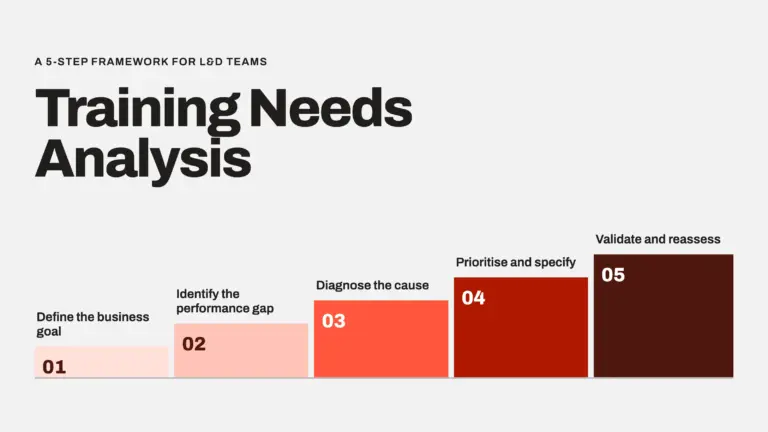
A strong L&D strategy starts with business alignment. Follow this five-step framework.
Step 1: Align with business goals. Ask leadership what skills the organization needs in the next 12 to 24 months. If the company is expanding into new markets, train for cross-cultural communication. If automation is increasing, train for digital skills. L&D must serve business outcomes.
Step 2: Conduct a skills gap analysis. Survey managers and employees. Review performance data. Identify where current skills fall short of what the business needs. This tells you what to train and who needs it most.
Step 3: Choose delivery methods. Match the training type to the best delivery method. Use e-learning for knowledge transfer. Use classroom sessions for hands-on practice. Use blended approaches for programs that need both. Modern LMS software supports all delivery methods from a single platform.
Step 4: Build content and assign roles. Create or source training materials. Assign L&D responsibilities to managers, not just HR. When managers own development conversations, engagement increases significantly.
Step 5: Set KPIs and measure. Define success metrics before you launch. Track completion rates, assessment scores, time to competency, and business impact. Without measurement, L&D is an expense. With measurement, it is an investment.
Five Pillars of an Effective L&D Program
The best L&D programs are built on five pillars that work together.
Onboarding. Every employee’s L&D journey starts on day one. Structured onboarding ensures new hires become productive fast. Organizations with strong onboarding see 82% better retention according to Brandon Hall Group. See our LMS for corporate training guide for corporate onboarding strategies.
Compliance Training. Legal and regulatory training is non-negotiable. POSH, workplace safety, data privacy, and industry-specific regulations must be covered. An LMS automates assignment, tracking, and certification for compliance.
Skills Training. Technical and soft skills training builds the capabilities employees need for their current roles. This includes product knowledge, tool proficiency, communication, and teamwork.
Leadership Development. Preparing future leaders requires coaching, mentoring, and structured development programs. Organizations that invest in leadership pipelines fill 60% of senior roles internally, saving significant recruitment costs.
Continuous Learning Culture. L&D should not be an annual event. Encourage ongoing learning through microlearning modules, knowledge sharing sessions, and self-directed courses. A culture of continuous learning keeps skills current and employees engaged.
Measuring Learning and Development ROI
Most L&D teams struggle to prove the value of their programs. Measuring ROI requires tracking outcomes at four levels. Level 1 is reaction. Did learners find the training useful? Collect this through post-training surveys. Level 2 is learning. Did they gain knowledge? Measure through assessments. Level 3 is behavior. Are they applying skills on the job? Track through manager feedback and performance data. Level 4 is results. Did training improve business outcomes like reduced errors, higher sales, or lower attrition? An LMS with built-in analytics makes tracking across all four levels practical. You can review LMS features that support ROI measurement.
How LMS Software Scales L&D Programs
Running L&D through spreadsheets and email does not scale. When your organization has 500 or 5,000 employees, you need a system. An enterprise learning management system centralizes all L&D content, automates assignments, tracks progress, and provides the analytics that prove training works.
A cloud-based SaaS LMS takes this further. Employees access training from any device. Managers see real-time dashboards. HR teams generate audit-ready reports. When the business launches a new product or enters a new market, updated training reaches every employee within hours. For organizations managing corporate learning management across locations, an LMS eliminates manual coordination. You can see how companies use this through real-world L&D case studies.
Using AlphaLearn for Enterprise Learning and Development
AlphaLearn is an ISO 27001:2022 certified LMS software that supports over 500,000 learners across BFSI, healthcare, retail, manufacturing, and facility management. For learning and development, AlphaLearn provides automated course assignment by role and department, AI-powered learning path recommendations, SCORM and xAPI content support, detailed analytics dashboards, completion certificates with tamper-proof timestamps, and multi-language support for pan-India deployments. Whether you are building an L&D program from scratch or modernizing an existing one, AlphaLearn gives you the platform to deliver, track, and improve every training initiative. Explore training solutions to see how the platform works across departments. You can also start your free LMS trial to test it with your own content.
Why L&D is the Top HR Priority in 2026
Skills have a shorter shelf life than ever. Technology changes faster. Roles evolve constantly. The organizations that win are the ones that learn faster than their competition.
Learning and development in 2026 is a strategic function that directly impacts retention, productivity, and growth. For Indian organizations competing for talent across every sector, a structured L&D strategy delivered through a reliable cloud LMS like AlphaLearn is the difference between an organization that keeps its best people and one that constantly replaces them.
Arjun Mehta
HR Technology Consultant
Arjun advises mid-size and enterprise teams on LMS selection, HR tech integration, and digital learning transformation. He has helped 40+ organisations deploy AlphaLearn across India and the Middle East.
Get Started
See AlphaLearn in action
500,000+ employees trained. ISO 27001:2022 certified.