Ask any experienced manager where they really learned to do their job, and the answer is rarely “in a classroom.” It is usually a difficult project, a demanding boss, or a mistake they had to fix themselves. The 70-20-10 model puts numbers on that instinct, and it has shaped how L&D teams plan development for three decades.
This guide explains what the model says, where it came from, how it looks for real roles in an Indian enterprise, where it falls short, and how to use a learning management system to support all three parts of it, not just the formal one.
What is the 70-20-10 model?
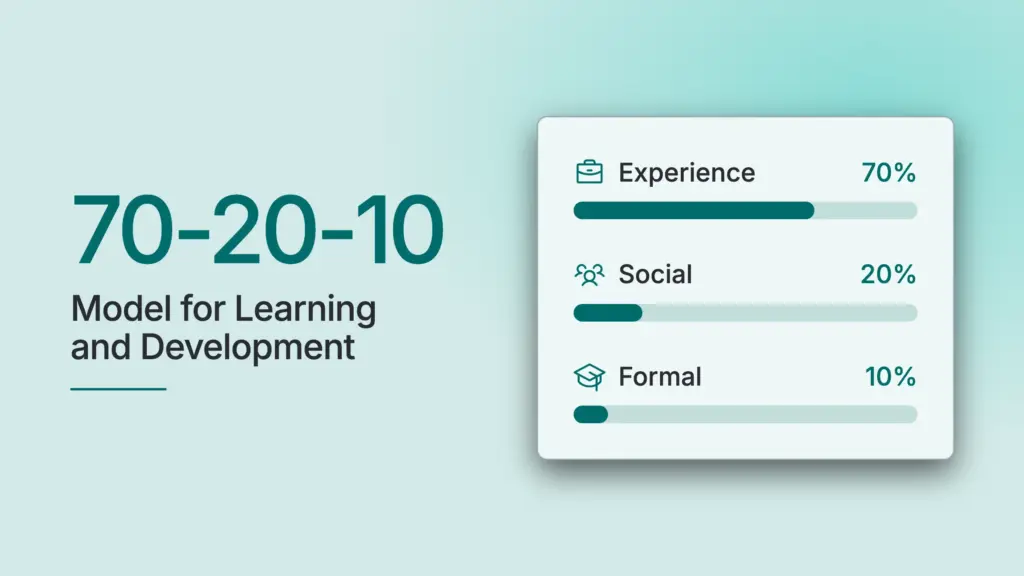
The 70-20-10 model describes where people say their most useful learning at work comes from. It splits development into three sources: experience, other people, and formal education.
Its real message is about balance. Most training budgets and most LMS activity sit in the formal 10%. The model asks L&D teams to design for the other 90% just as deliberately as they design courses.
It is also written as 70:20:10 and called the 70-20-10 rule or the 70-20-10 principle. All three names refer to the same idea.
Where did the 70-20-10 model come from?
The model traces back to the 1980s and research at the Center for Creative Leadership in the United States. Morgan McCall, Michael Lombardo, and Ann Morrison studied how successful executives had developed, and published their findings in the book The Lessons of Experience in 1988.
The ratio itself came a few years later. Michael Lombardo and Robert Eichinger set out the 70, 20, and 10 split in 1996, and it has been the standard reference point for the model ever since.
The research has limits worth knowing before you lean on it too heavily. It was based on what executives remembered about their own careers, not a controlled study with a control group. Treat the numbers as a direction, not a measurement.
What do the 70, 20, and 10 stand for?
The three parts depend on each other more than the clean split suggests. A course gives a new sales executive the product knowledge. Shadowing a senior colleague shows how that knowledge is used in a real conversation. Running their own customer meetings turns it into skill. Remove any one part and the other two work less well.
What does the 70-20-10 model look like in practice?
New sales executive
- 10%: product, pricing, and compliance modules, followed by a certification test.
- 20%: joint calls with a senior colleague, weekly pipeline reviews with the manager.
- 70%: owning a small territory from week three, with real targets and real objections.
A sales training LMS makes sure the formal part is finished and certified before the first customer conversation.
Shop-floor operator
- 10%: safety induction and SOP modules in the operator’s own language.
- 20%: a buddy system with an experienced operator, daily toolbox talks with the supervisor.
- 70%: supervised work on the line, moving to independent operation once the supervisor signs off.
In manufacturing, the 70% carries real risk, which is why the formal part has to come first. An LMS for manufacturing sequences induction before floor access, instead of leaving it to chance.
First-time manager
- 10%: short modules on feedback, delegation, and performance conversations.
- 20%: a mentor outside the reporting line, peer circles with other new managers.
- 70%: leading a team through a full appraisal cycle, running a project with a real budget.
Is the 70-20-10 model still valid?
As a mindset, yes. As a formula, no. The model is right that most capability is built through work and through other people. It is wrong if read as an instruction to spend exactly 10% of effort on formal training.
- The ratio is not evidence-based. It came from self-reported recollections of senior executives, mostly in one country and one era, not from a controlled study.
- The mix changes by role. A new joiner in a regulated function needs far more than 10% formal training. POSH awareness, safety, and product compliance cannot be left to experience.
- It has been misused to cut budgets. “Only 10% matters” is a misreading. Formal training is what makes the other 90% safe and productive in the first place.
- The 70% does not happen by itself. Experience only teaches when it is planned, stretched, and followed by reflection. Unstructured experience mostly teaches habits, good and bad.
Use 70-20-10 as a question to ask of every programme: have you designed the practice and the support, or only the course?
How do you apply the 70-20-10 model in an Indian enterprise?
- Start from the role, not the ratio. List what a person in the role must actually be able to do. Competency mapping gives you that list.
- Decide what needs formal training. Compliance, safety, product knowledge, and systems training belong in the 10%. Make this part short, clear, and assessed.
- Design the experience. For each skill, name the task, project, or rotation where the person will practise it, and when. Write it into the plan the same way you would schedule a course.
- Assign the people. Name the manager, mentor, or buddy responsible for the 20%, and give them a simple guide to what to observe and discuss.
- Sequence it as one path. A course, then shadowing, then a real task, then a review. Role-based learning paths let you assign that sequence automatically by role.
- Review after 90 days. Check what was completed, what the manager observed, and what changed in performance.
For multi-location and frontline workforces, two adjustments matter. Deliver the formal part on mobile and in regional languages, and keep it in short modules; our guide to microlearning explains how. And make the supervisor’s role explicit, because on a shop floor or in a branch, the supervisor is the 20%.
How does an LMS support all three parts of the 70-20-10 model?
An LMS is usually bought for the 10%. Used well, it gives structure to the other two parts as well.
Blended delivery is where the three meet. A path that combines self-paced modules, a live session, and an on-the-job assignment is 70-20-10 in practice. Our guide to blended learning covers the common models, and the AlphaLearn hybrid LMS keeps classroom, virtual, and self-paced activity in one record.
Knowledge held by experienced staff is part of the 20%. When a senior person moves on, a structured knowledge transfer plan keeps that learning available to the rest of the team.
How do you measure a 70-20-10 programme?
Do not try to measure the percentages themselves. Measure whether capability actually improved.
- Formal part: completion and assessment scores.
- Social part: whether the planned coaching or mentoring sessions took place, and what the manager observed.
- Experience part: completion of the assigned tasks or projects, and the quality of the output.
- Outcome: the business measure the programme was built to move, such as time to first sale, error rates, or audit findings.
The Kirkpatrick Model gives a clear structure for this, and our guide to learning analytics metrics lists the numbers worth tracking at each level.
Frequently asked questions
Q: What is the 70-20-10 model?
A: The 70-20-10 model is a learning and development framework which holds that roughly 70% of workplace learning comes from on-the-job experience, 20% from other people through coaching, mentoring, and feedback, and 10% from formal training such as courses and workshops.
Q: Who created the 70-20-10 model?
A: The model is credited to Morgan McCall, Michael Lombardo, and Robert Eichinger, based on research with executives at the Center for Creative Leadership in the 1980s. Lombardo and Eichinger published the 70-20-10 ratio in 1996.
Q: What do the 70, 20, and 10 stand for?
A: The 70 stands for learning from on-the-job experience such as stretch assignments and new projects, the 20 stands for learning from other people such as coaching and mentoring, and the 10 stands for formal education such as courses, certifications, and workshops.
Q: Is the 70-20-10 model still valid?
A: As a mindset, yes. As a strict formula, no. The original research was based on what successful executives remembered about their own development, not a controlled study, and the right mix changes by role, experience level, and how regulated the work is.
Q: How do you apply the 70-20-10 model?
A: Start from what the role actually requires rather than the ratio itself, decide which parts need formal training, design real tasks and assignments for the experiential part, name the managers or mentors responsible for the social part, sequence all three into one learning path, and review progress after 90 days.
Q: Does 70-20-10 mean formal training is only 10% important?
A: No. Formal training is often what makes the other 90% possible. It gives people the baseline knowledge they then practise on the job and discuss with managers and peers. Compliance, safety, and product training still need structured courses.
Q: How does an LMS support the 70-20-10 model?
A: An LMS delivers the formal 10% through courses and assessments, supports the social 20% through forums, live sessions, and manager involvement, and structures the experiential 70% through assignments, learning paths, and skill tracking linked to real work.
Build development paths that go beyond the course
AlphaLearn lets you combine courses, live sessions, assignments, and skill tracking in one learning path, in 12 Indian languages and on mobile.
Start Free Trial Request a DemoNeha Iyer
Learning Experience Designer
Neha specialises in eLearning design, blended learning models, and learner engagement strategy. She brings a learner-first perspective to instructional design, with a focus on mobile-first delivery for deskless workforces.
Get Started
See AlphaLearn in action
500,000+ employees trained. ISO 27001:2022 certified.