
Short answer: A training management system (TMS) manages the business of training – scheduling, logistics, budgets and enrolments. A learning management system (LMS) manages the delivery of learning – online courses, assessments, completions and compliance records. They solve different problems, and many Indian enterprises need both functions in one platform.
Buying the wrong system is expensive. A pharma company that buys a standalone TMS for GMP compliance cannot track individual assessment scores or issue audit-ready certificates – it can only record attendance. A BFSI firm that buys a pure LMS for instructor-led city-wide POSH refreshers may struggle to manage trainer booking, room allocation and travel costs. This guide defines both systems, compares them side by side across eight decision dimensions, and gives a practical framework for Indian L&D and HR teams choosing between them in 2026.
For market context: the global learning management system market is projected to grow from USD 28.58 billion in 2025 to USD 123.78 billion by 2033 at a CAGR of 19.9% (Grand View Research, 2024). The training management software segment is a smaller but growing sub-market as enterprises move toward unified platforms that handle both delivery and logistics.
What is a training management system (TMS)?
A training management system (TMS), also called training management software or TMS software, is a platform that handles the operational and administrative side of training. It answers the logistics questions: who is teaching, where, when, how many seats are available, what does it cost, and was attendance recorded? A TMS does not typically host or deliver learning content itself.
A TMS is the back-office system for training operations – most commonly used by:
- Training providers (commercial or in-house) scheduling instructors across multiple locations
- L&D operations teams running high-volume instructor-led training (ILT) programmes
- Enterprises managing external training vendors, trainers and training budgets
What a TMS manages:
- Instructor-led and classroom session scheduling across locations and time zones
- Trainer, room and equipment booking, availability and conflict detection
- Course catalogues, learner enrolments, waiting lists and attendance registers
- Training budgets, cost-per-head, invoicing and commercial operations for training businesses
- Reporting on training utilisation, trainer performance and operational efficiency
A TMS tracks whether a person showed up. It does not track what they learned, whether they passed an assessment, or whether their certification has been renewed. For that, you need an LMS.
What is a learning management system (LMS)?
A learning management system (LMS) is software that hosts, delivers and tracks digital learning. The LMS is the system of record for what employees learned, how they performed, and whether they are certified and compliant. It is the engine of e-learning, self-paced training, mobile learning and compliance programmes.
What an LMS provides:
- Hosting and delivery of online courses, SCORM 1.2, SCORM 2004 and xAPI (Tin Can API) content
- Per-learner progress tracking, quiz scores and completion records
- Certifications, certificate expiry, auto-renewal reminders and audit-ready compliance records
- Self-paced, mobile and remote learning at scale – across distributed Indian workforces
- Assessment engines, branching scenarios and interactive content playback
- Learner dashboards, manager dashboards and real-time analytics on training effectiveness
For a detailed breakdown of what an LMS can do for your organisation, see the benefits of an LMS. For a full feature comparison of platforms available in India, see our best LMS in India 2026 guide.
TMS vs LMS: side-by-side comparison
The table below breaks down the core differences across the eight dimensions that matter most when making a buying decision.
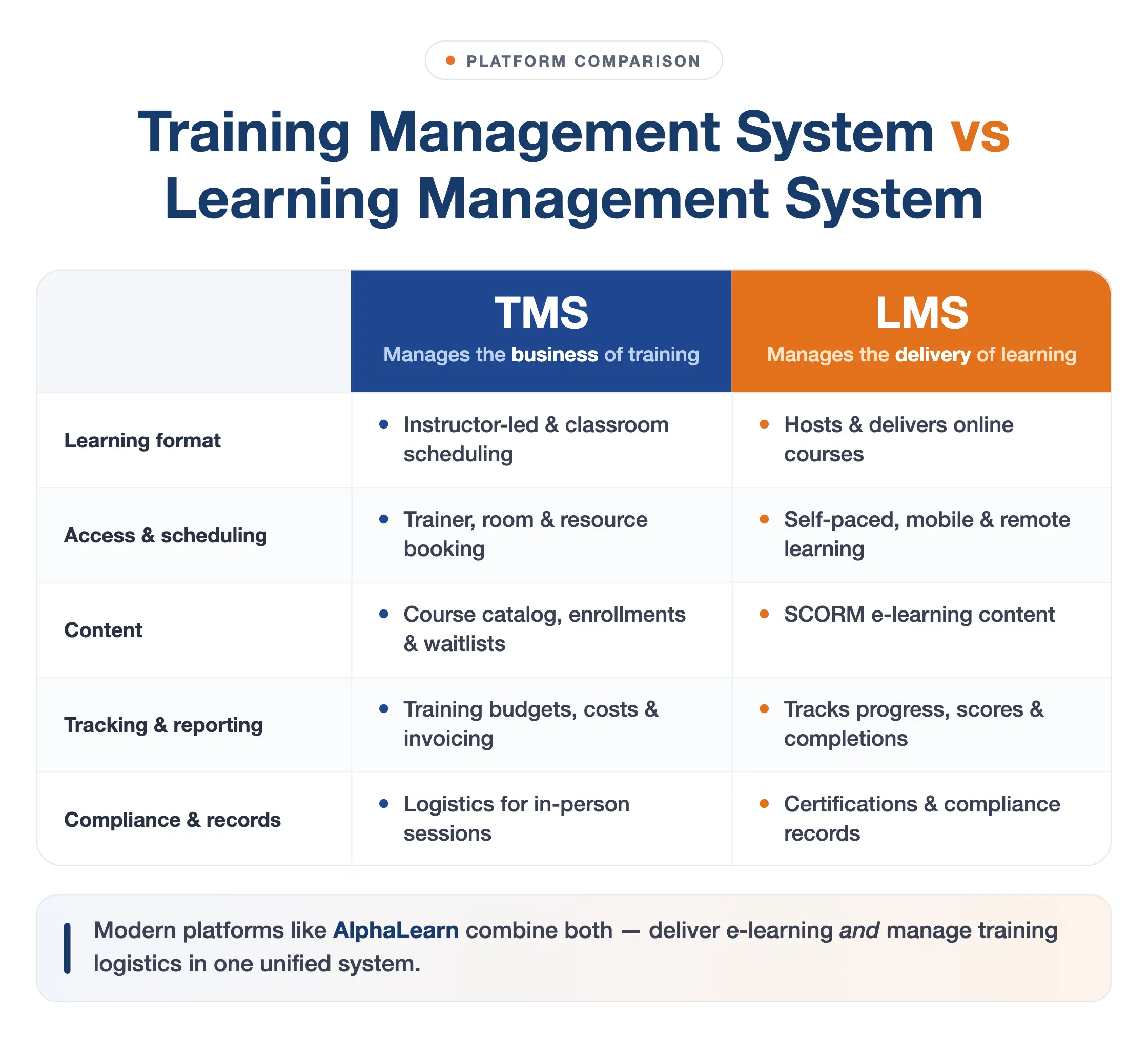
| Dimension | Training Management System (TMS) | Learning Management System (LMS) |
|---|---|---|
| Primary purpose | Manage training operations and logistics | Deliver and track learning |
| Core focus | Scheduling, resources, costs | Courses, content, completions |
| Training type | Instructor-led / classroom | Online / self-paced / blended |
| Key features | Booking, enrolments, waitlists, invoicing | Course hosting, assessments, certificates |
| Content hosting | Usually none | Yes – SCORM, xAPI, video, quizzes |
| Compliance tracking | Attendance register only | Completion, scores, certificates and audit trail |
| HRMS integration | Limited – mainly for billing | Yes – Keka, Darwinbox, SAP, Workday via API/SSO |
| Best for | Managing in-person training as a business | Delivering e-learning and compliance at scale |
Where they overlap – and why the line is blurring in 2026
The distinction between a TMS and an LMS is narrowing, because modern cloud LMS platforms increasingly do both. Features that were once TMS-only – instructor-led training scheduling, trainer and room booking, blended learning management, enrolment workflows – are now standard on leading LMS platforms.
This matters for three practical reasons:
- Most enterprises run blended training – not purely online or purely classroom. An HDFC Bank branch manager needs both the weekly e-learning compliance module (LMS) and the quarterly in-branch training session managed by the L&D team (TMS). Buying two separate systems that do not share data creates reporting gaps and duplicate maintenance.
- Data continuity – if enrolment data lives in a TMS and completion data lives in an LMS, you cannot easily produce a single compliance status report. Regulators (SEBI, RBI, CDSCO) expect consolidated audit trails.
- Total cost of ownership – two vendors, two contracts, two integrations and two training programmes for L&D staff costs significantly more than a single combined platform, both in licence fees and in operational overhead.
For related terminology, see the difference between an LMS and other learning platforms, or how an enterprise LMS differs from SMB tools.
TMS vs LMS use cases – which do you need?
Your ideal system depends on your training mix, compliance requirements and workforce distribution. Here are the most common scenarios for Indian enterprises:
Scenario 1: Mostly instructor-led, training-as-a-business
A training company scheduling instructors across Mumbai, Delhi and Bengaluru, invoicing clients per session, and managing waiting lists for popular workshops. This is the clearest TMS use case – the core need is logistics and billing, not content hosting.
Scenario 2: Online-first, compliance-heavy, distributed workforce
A BFSI firm pushing mandatory POSH Act refreshers, AML training and NISM certification modules to 8,000 staff spread across 300 branches and remote locations. An LMS is essential here – you need per-learner completion records, assessment scores and auto-expiry reminders on certifications. A TMS tracks whether someone showed up; it cannot prove what they scored on an AML assessment.
See how compliance training software handles these requirements, or explore specific programmes like compliance training on AlphaLearn.
Scenario 3: Blended learning – ILT plus e-learning in one system
A pharmaceutical company running live GMP workshops (instructor-led, must track attendance and room booking) alongside self-paced CDSCO audit-ready modules (must track individual scores and certificate expiry). A manufacturer combining classroom safety inductions with mobile SOP refreshers for shop-floor workers. These scenarios need both functions – and a combined platform is almost always the right answer. See how corporate training in India has evolved toward blended models.
Scenario 4: Frontline and deskless workforce training
A retail chain training 15,000 frontline employees across 500 stores in Hindi, Tamil, Marathi and Bengali. A standalone TMS cannot deliver the mobile-first, vernacular, bite-sized training that frontline workers need. A training management platform with built-in LMS capabilities – including offline sync and 12-language support – is required. Microlearning content formats are particularly effective in this scenario.
How to choose between a TMS, an LMS, or a combined platform
Work through these six questions in order. If you can answer yes to more than two, you need an LMS or combined platform:
- Training mix – What percentage of your training is online vs instructor-led? If more than 30% is online or blended, a pure TMS will not serve you. If 100% is classroom only, a TMS may be sufficient.
- Compliance requirements – Do you need audit-ready completion records with individual assessment scores? Any regulatory body (SEBI, RBI, CDSCO, FSSAI, Factories Inspectorate) that reviews training records expects more than an attendance sheet. An LMS or combined platform is essential.
- Scale and geography – Do you have employees in multiple states or countries? Large, distributed Indian workforces require cloud-based SaaS LMS deployment for consistent access. For large organisations, see the enterprise LMS criteria.
- HRMS integration – Is your HR data in Keka, Darwinbox, SAP SuccessFactors or Workday? An LMS that integrates via API or SSO means user provisioning, department-level reporting and automatic deactivation work without manual CSV uploads.
- Budget and TCO – Two systems (a standalone TMS + a separate LMS) typically cost 40-60% more over a 3-year horizon than a single combined platform, when you factor in integration maintenance, dual vendor support contracts and staff training time. For pricing benchmarks, see LMS pricing in India 2026.
- India-readiness – Does the platform host data in India (AWS Mumbai region for DPDP Act 2023 compliance), carry an ISO 27001:2022 certificate, quote in INR with GST invoicing, and support regional languages? This is non-negotiable for many Indian enterprises, particularly those in BFSI, healthcare and pharma.
For a deeper evaluation process, see our complete LMS buyer’s guide for Indian enterprises. If you are comparing specific platforms, see AlphaLearn vs TalentLMS vs Moodle.
What happens when you use only a TMS for compliance training (a common mistake)
A recurring error in Indian L&D procurement: a manufacturing HR team buys a TMS for scheduling GMP, safety and EHS training sessions – often because the procurement team equates “managing training” with “scheduling training”. They get attendance registers and room bookings. But when a factory inspector or ISO auditor asks for evidence that specific employees completed and passed the annual safety assessment, the TMS cannot produce it. The data does not exist.
The same risk applies to POSH Act compliance in BFSI and IT – a TMS records who attended a session, but cannot demonstrate that the individual understood the content through an assessment. Under the Sexual Harassment of Women at Workplace (Prevention, Prohibition and Redressal) Act 2013, organisations are expected to maintain training records; assessment-level records significantly strengthen that position.
This is why LMS for corporate training has become the default for compliance-driven organisations, not just training providers.
How AlphaLearn combines training delivery and management
AlphaLearn is a cloud LMS built for Indian enterprises that also handles the operational training management functions that most organisations need – instructor-led session scheduling, blended learning management, enrolments, compliance reporting and certification management – in one India-built platform. Key credentials:
- 500,000+ employees trained across 200+ Indian enterprises
- ISO 27001:2022 certified – externally audited information security
- AWS Mumbai (ap-south-1) hosting – DPDP Act 2023 compliant data residency
- 12 Indian languages – Hindi, Tamil, Telugu, Kannada, Malayalam, Marathi, Bengali, Gujarati, Punjabi, Odia, Assamese, Urdu
- SCORM 1.2, SCORM 2004 and xAPI content support
- Native integrations with Keka, Darwinbox, SAP, Salesforce, Zoom and Microsoft Teams
- INR pricing with GST invoicing – no currency conversion overhead
That means you get both TMS capabilities (ILT scheduling, enrolments, blended learning management) and full LMS capabilities (e-learning delivery, assessments, compliance records, certificates) without stitching two systems together. Explore the full feature set or see how AlphaLearn supports corporate training at scale.
Next step: Request a demo to see how AlphaLearn manages both training delivery and logistics, or start a free trial.
Frequently asked questions
What is the difference between a TMS and an LMS?
A training management system (TMS) manages the logistics and business of training – scheduling, resources, enrolments and costs – while a learning management system (LMS) manages the delivery and tracking of learning, including online courses, assessment scores, progress and certifications. A TMS runs training operations; an LMS delivers and records the learning itself.
Is a training management system the same as an LMS?
No. A TMS focuses on organising and administering training – especially instructor-led sessions – while an LMS focuses on hosting, delivering and tracking learning content. The line is blurring because modern cloud LMS platforms now include ILT scheduling and enrolment management, making a standalone TMS unnecessary for most enterprises.
Do I need both a TMS and an LMS?
If you run a mix of instructor-led and online training, you need both functions. The most cost-effective approach in 2026 is a single combined cloud platform rather than two separate systems. Two systems mean two vendor contracts, duplicate user data and manual reconciliation of attendance and completion records.
What is training management software used for?
Training management software is used to schedule instructor-led sessions, book trainers and rooms, manage course catalogues and enrolments, handle training budgets and invoicing, and report on training utilisation. It is the operational backbone for organisations – typically training providers or enterprises with large classroom training operations – that need to manage training as a logistical and financial process.
Can an LMS replace a training management system?
A modern LMS can replace a standalone TMS when it includes instructor-led training scheduling, enrolment management and blended learning support. For organisations whose training is mostly online, an LMS alone is sufficient. For commercial training companies that invoice clients per session and manage complex trainer rosters, a dedicated TMS may still be required – but these are an increasingly small share of the market.
Which is better for compliance training – a TMS or an LMS?
An LMS is significantly better for compliance training. It tracks course completions, individual assessment scores and certifications with an audit-ready record – the evidence standard expected by regulators including SEBI, RBI, CDSCO, FSSAI and Factories Inspectorates. A TMS tracks attendance for in-person sessions but cannot record what learners scored or certify that they understood the content. For compliance programmes under the POSH Act 2013, Factories Act, GMP, or DPDP Act 2023, always use an LMS or combined platform.
What does “training management system” mean in HR?
In HR, a training management system refers to software that manages the administrative and logistical aspects of employee training – scheduling, enrolments, trainer assignments, attendance records and training budgets. In practice, many HR teams use the term loosely to mean any system that manages training, including LMS platforms. When evaluating vendors, clarify whether the system can both schedule training (TMS function) and track individual learning outcomes (LMS function).
Rohit Desai
Compliance & Training Manager
Rohit has led compliance training programmes in pharma, manufacturing, and healthcare for over a decade. He writes about POSH, GMP, safety regulations, and building audit-ready training records on an LMS.
Get Started
See AlphaLearn in action
500,000+ employees trained. ISO 27001:2022 certified.