
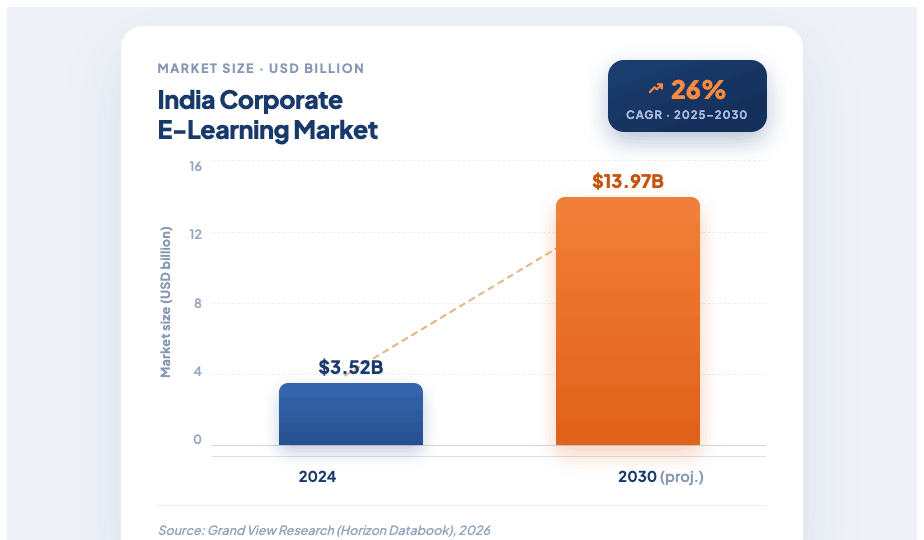
India’s corporate e-learning market was valued at USD 3.52 billion in 2024 and is projected to reach USD 13.97 billion by 2030, compounding at roughly 26% per year (Grand View Research, 2025). A separate estimate from IMARC Group puts the broader Indian e-learning market at USD 9.13 billion in 2024, reaching USD 23.18 billion by 2034. Both projections tell the same story: Indian enterprises are moving employee training online at a pace matched by almost no other major economy.
The reason is structural. India’s enterprise workforce is distributed across geographies, speaks more than a dozen languages, and operates in a regulatory environment that is growing more demanding – from the Digital Personal Data Protection Act 2023 to sector-specific mandates under the Factories Act, GMP regulations, and POSH compliance requirements. Classroom training cannot scale across 200 locations in 12 states. An online learning platform can.
This guide covers everything an L&D or HR leader at an Indian enterprise needs to know in 2026: what online learning platforms are, how they differ from an LMS or LXP, the five types used in corporate training, must-have features, and a practical six-step framework for choosing the right platform for your organisation.
What is an online learning platform?
An online learning platform is software that enables organisations to create, deliver, track, and manage structured training programmes over the internet. For corporate use, it replaces or supplements classroom instruction with digital content – video lessons, interactive modules, assessments, and certifications – that employees can access from any device at any time.
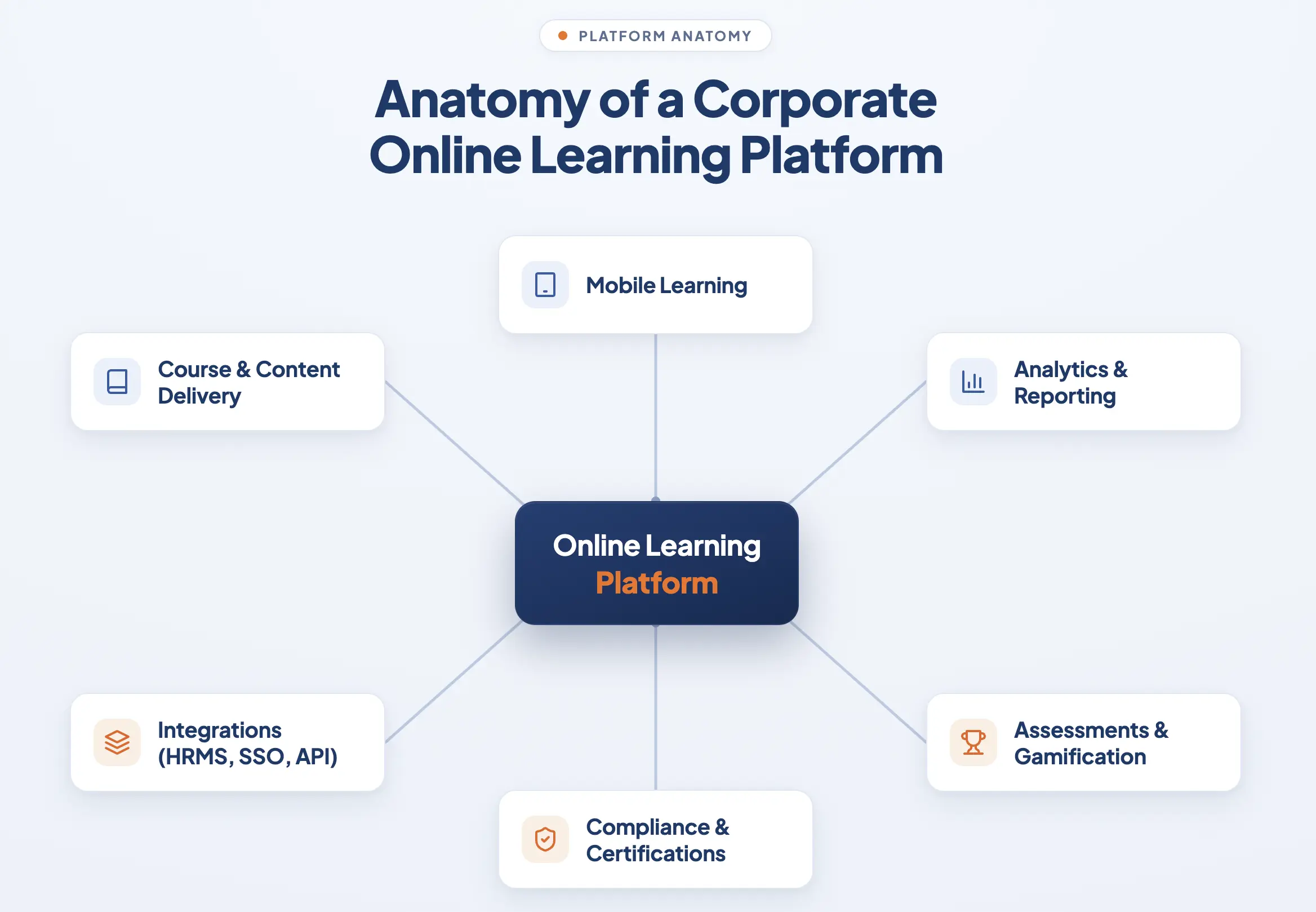
The term is broad by design. It covers platforms with very different architectures and use cases, from a traditional Learning Management System (LMS) focused on structured course delivery and compliance tracking, to a Learning Experience Platform (LXP) that curates personalised content feeds, to a mobile-first app that delivers microlearning in five-minute bursts to factory workers.
What all corporate online learning platforms share is a data layer: every completion, score, and time-on-content is logged and reportable. This is what distinguishes them from a simple video library or a shared Google Drive of training documents. The audit trail is not just useful – in regulated industries, it is mandatory. See our detailed guide on what e-learning is for a broader introduction to the concept.
Online learning platform vs LMS vs LXP: what is the difference?
These three terms are frequently used interchangeably but they describe different things. For Indian enterprises evaluating vendors, understanding the distinctions prevents expensive mismatches between what a platform does and what your organisation actually needs.
| Dimension | Online Learning Platform (general) | LMS (Learning Management System) | LXP (Learning Experience Platform) |
|---|---|---|---|
| Primary purpose | Broad category covering all digital training delivery | Structured course delivery, compliance tracking, certifications | Personalised learning journeys, content discovery, skill development |
| Content model | Varies by type | Admin-assigned, structured curricula (SCORM, xAPI, AICC) | Self-directed, curated from internal + external sources |
| Compliance tracking | Depends on platform | Core capability – audit trails, certificates, mandatory enrolment | Secondary – LXPs prioritise engagement over compliance |
| Learner control | Varies | Admin-driven enrolment and paths | Learner-driven discovery and self-enrolment |
| Typical use in India | All corporate training | Onboarding, compliance, certification, skills training | Leadership development, knowledge sharing, upskilling programmes |
| Examples | AlphaLearn, Moodle, TalentLMS, Disprz | AlphaLearn, Moodle, TalentLMS, SAP SuccessFactors Learning | Degreed, EdCast, Cornerstone |
For most Indian enterprises deploying corporate training – onboarding new hires, running mandatory POSH and compliance programmes, or upskilling functional teams – a modern LMS covers all requirements at a fraction of the complexity and cost of a full LXP stack. See our full comparison of LXP vs LMS for a detailed breakdown by use case.
5 types of online learning platforms used in corporate training
Not all online learning platforms are built for the same job. The five types most commonly deployed by Indian enterprises:
1. Learning Management System (LMS)
An LMS is the backbone of corporate training for most organisations. It handles course creation, enrolment, delivery, assessment, and reporting. A modern LMS supports SCORM 1.2, SCORM 2004, xAPI (Tin Can), and AICC content formats – meaning content built in any authoring tool (Articulate Storyline, iSpring, Adobe Captivate, or a built-in AI course builder) will play correctly and track completion. For Indian enterprises, the critical LMS capabilities are: mobile-first delivery, offline mode for field and shopfloor workers, 12 Indian language support, and compliance documentation that satisfies Factories Act, GMP, POSH, and RBI training mandates. Read our guide on what a Learning Management System is for a full introduction.
2. Learning Experience Platform (LXP)
An LXP sits above or alongside an LMS and focuses on personalised learning journeys. Rather than assigning fixed courses, an LXP surfaces content recommendations based on an employee’s role, skills gaps, and past learning behaviour. LXPs are used primarily by large enterprises with sophisticated L&D teams running leadership development and continuous learning programmes. For most Indian SMEs and mid-market enterprises, an LXP adds complexity without proportional value – a feature-rich LMS with AI recommendations delivers most of the benefit.
3. Virtual Classroom Platforms
Tools like Zoom, Microsoft Teams, and Google Meet with learning integrations enable synchronous online instruction – live webinars, instructor-led training, and virtual workshops. They work best for soft skills, leadership programmes, and interactive sessions where live discussion matters. They are not a replacement for an LMS: virtual classrooms cannot track asynchronous completion, manage certifications, or run compliance programmes at scale. Most organisations use them alongside an LMS – scheduling virtual sessions within the LMS and tracking attendance and recording access through it.
4. Content Libraries and Marketplaces
Platforms like Coursera for Business, LinkedIn Learning, and Udemy Business give employees access to thousands of pre-built courses from external instructors. They work well for generic professional development – project management, Excel skills, communication – but they do not cover organisation-specific training: your SOPs, your products, your compliance requirements. Indian enterprises typically pair a content library with an LMS that handles custom internal content and mandatory compliance programmes.
5. Mobile Learning and Microlearning Apps
Purpose-built mobile learning apps deliver short, focused training modules (2–10 minutes) optimised for smartphones. They are the right tool for frontline and blue-collar workforces – factory workers, retail associates, field sales teams, delivery personnel – who do not have desk access and learn best in short bursts between tasks. The most effective mobile learning platforms include gamification (points, badges, leaderboards), offline mode, and support for Indian regional languages. A modern LMS like AlphaLearn bundles this mobile learning capability natively, eliminating the need for a separate app.
Must-have features of a corporate online learning platform
Not every feature in a vendor’s marketing list matters equally. The ten capabilities that most directly determine success for Indian enterprise deployments:
| Feature | Why it matters for Indian enterprises |
|---|---|
| Mobile-first delivery with offline mode | Large portions of Indian enterprise workforces – shopfloor workers, field sales teams, retail associates – do not have desks. Training must reach them on mobile, including in areas with poor connectivity. |
| 12 Indian language support | Frontline workers across manufacturing, retail, and logistics learn faster and retain more when trained in Hindi, Marathi, Tamil, Gujarati, Kannada, Telugu, Bengali, or their native language. English-only platforms consistently underperform with non-desk workforces. |
| AI course builder | L&D teams in Indian enterprises are typically small relative to workforce size. An AI course builder that generates structured modules, assessments, and quizzes from a topic brief or uploaded document cuts development time from weeks to hours. |
| Compliance and certification tracking | Auto-enrolment in mandatory programmes (POSH, safety inductions, regulatory training), digital certificates with QR verification, audit-ready completion records. Essential for any regulated sector. |
| SCORM / xAPI compatibility | Ensures content built in any authoring tool plays correctly and reports completion data accurately. Without SCORM/xAPI support, you are locked into the platform’s own content tools forever. |
| HRMS integration | Auto-enrolment from Keka, Darwinbox, GreytHR, SAP SuccessFactors, or Zoho People on day one. Eliminates manual user management and ensures no new hire misses their induction, especially in high-attrition industries. |
| Reporting and analytics | Completion rates by department, location, and cohort. Assessment score distributions. Time-on-content. These metrics are what L&D teams use to demonstrate ROI and identify underperforming programmes. Explore all AlphaLearn analytics features. |
| Data residency in India | Under the DPDP Act 2023, enterprise data must be handled in compliance with Indian data protection requirements. Hosting on AWS Mumbai (ap-south-1) ensures your employee training data stays within India and simplifies compliance. |
| Gamification | Points, badges, leaderboards, and completion streaks drive voluntary learning beyond mandatory programmes. Especially effective for sales teams and frontline workforces where completion rates on non-mandatory content tend to be low. |
| ISO 27001:2022 certification | The international standard for information security management. Signals that the vendor has independently verified security controls around employee data – a requirement for BFSI, healthcare, and pharma procurement teams, and increasingly a procurement checklist item across all enterprise sectors. |
Why Indian enterprises are adopting online learning platforms faster than ever
Several structural forces are accelerating adoption in India specifically:
Regulatory pressure is increasing
Indian enterprises now operate under a growing stack of training-related mandates. The POSH Act (Sexual Harassment of Women at Workplace Act 2013) requires annual training for all employees. The Factories Act 1948 mandates safety inductions and retraining for manufacturing workers. Pharmaceutical manufacturers must comply with Schedule M GMP training requirements under CDSCO. Financial services firms face RBI and SEBI mandatory training programmes. An online learning platform is the only scalable way to run these programmes across large, distributed workforces with audit trails that satisfy inspectors.
The DPDP Act 2023 creates new data requirements
The Digital Personal Data Protection Act 2023 places new obligations on how Indian enterprises handle employee data. Choosing an online learning platform hosted on AWS Mumbai (ap-south-1) with ISO 27001:2022 certification simplifies compliance significantly compared to platforms hosted abroad or without current security certifications. For procurement teams, data residency is now a mandatory checkbox item, not a nice-to-have.
India’s workforce is distributed and multilingual
India’s enterprises employ people across multiple states, in factories, offices, and retail locations spread from Srinagar to Kanyakumari. A manufacturing company’s shopfloor in Tamil Nadu and its head office in Mumbai cannot both be served well by the same English-language classroom training programme. Online learning platforms that support 12 Indian languages including Hindi, Tamil, Marathi, Bengali, and Gujarati let organisations deploy one training programme that works for every employee regardless of their location or language.
The workforce is younger and mobile-first
India has one of the youngest large workforces in the world. A significant proportion of the enterprise workforce entered their roles after 2020, with mobile-first digital habits. They expect training to be available on demand, on their phones, in short consumable modules – not in three-hour classroom sessions scheduled weeks in advance.
Remote and hybrid work normalised enterprise e-learning
The shift to remote and hybrid work in 2020–22 forced the adoption of online learning tools at enterprises that had previously relied entirely on in-person training. Having built the infrastructure, most organisations have no intention of going back. The outcome is that what was once a competitive advantage is now the baseline expectation for enterprise L&D teams.
How to choose the right online learning platform for your organisation
Choosing an online learning platform is a significant procurement decision – most contracts run 1–3 years, migration between platforms is costly, and the wrong choice creates real operational problems (low adoption, compliance gaps, over-budget implementation). The six-step framework below is designed for L&D and HR leaders at Indian enterprises evaluating platforms in 2026.
Step 1: Define your primary use case
Online learning platforms are not all built for the same job. If your primary requirement is compliance and certification tracking – POSH, safety inductions, regulatory mandates – you need a platform with strong mandatory enrolment, audit trails, and certificate management. If you need to train a distributed frontline workforce, mobile-first delivery and regional language support are non-negotiable. If your focus is onboarding and skills development for desk workers, the requirements are different again. Start by ranking your use cases in order of business importance before looking at any vendor.
Step 2: Map your technical requirements
Work through: How many users? What content formats do you use (SCORM, video, PDF, live sessions)? Which HRMS do you use (Keka, Darwinbox, SAP, GreytHR)? Do you need offline access? What devices will learners use? Do you have an L&D team to create content, or do you need AI-assisted authoring? For regulated industries, add: what compliance documentation format do auditors require? The answers to these questions quickly eliminate most platforms from consideration. See our detailed guide on how to choose the right LMS for corporate training.
Step 3: Evaluate deployment options
The two main deployment models are cloud LMS (hosted by the vendor, typically on AWS or Azure) and on-premise LMS (installed on your own servers). Cloud LMS is faster to deploy (live in 2–5 days vs weeks for on-premise), lower maintenance burden, and easier to scale. On-premise offers maximum data control and is preferred by some banking and defence organisations with strict data sovereignty requirements. For most Indian enterprises, a cloud LMS hosted on AWS Mumbai is the practical default.
Step 4: Run a structured pilot
Before committing, run a 2–3 week pilot with 20–50 real users from your actual workforce – not the IT team. Include people who represent your most challenging segment: factory workers using the mobile app, field sales reps on 3G connections, senior managers who have never used an LMS. A pilot that only involves desk workers in the head office will not surface the issues that will derail your rollout. Measure completion rate, time to first completion, and support tickets generated during the pilot.
Step 5: Verify security and compliance credentials
Request the vendor’s ISO 27001 certificate (verify it is current – ISO 27001:2022, not the older 2013 version). Ask specifically about data hosting location (not just “we use AWS” – ask “which region?”). Request their last VAPT (Vulnerability Assessment and Penetration Testing) report. For BFSI and healthcare, verify that the platform supports audit trail exports in the format your regulators require. Skipping this step creates procurement risk that is difficult to remediate after contract signature.
Step 6: Evaluate total cost of ownership, not just licence cost
The licence fee is the most visible cost but often not the largest. Factor in: implementation and onboarding fees, content migration costs if you are moving from another platform, HRMS integration setup, administrator training, and the internal time cost of your L&D team during go-live. A platform that costs 20% more per year but deploys in 5 days vs 6 weeks with dedicated India-based support will typically have lower total cost over a 3-year contract. Ensure the vendor quotes in INR with GST invoicing – USD-denominated contracts create currency exposure and complicate procurement for listed companies.
AlphaLearn: a corporate online learning platform built for Indian enterprises
AlphaLearn is an AI-powered online learning platform built specifically for the requirements of Indian enterprises. It is used by 200+ enterprises across BFSI, pharmaceuticals, manufacturing, retail, and IT, with over 500,000 employees trained to date.
Key capabilities relevant to Indian enterprise deployments:
- AI Course Builder – generate a structured course from a topic brief, document, or video in minutes. Cuts content development time by up to 70% compared to traditional authoring tools.
- 12 Indian language support – training delivered in Hindi, Tamil, Marathi, Bengali, Gujarati, Kannada, Telugu, and 5 more. Critical for frontline and blue-collar workforces.
- Mobile-first with offline mode – available on Android and iOS. Learners complete modules without an internet connection; progress syncs when connectivity returns.
- HRMS integrations – pre-built connectors for Keka, Darwinbox, GreytHR, SAP SuccessFactors, Oracle HCM, and Zoho People. New hires auto-enrol on day one.
- Compliance tracking – auto-enrolment in mandatory programmes (POSH, safety, regulatory), digital certificates with QR verification, audit-ready training matrices.
- ISO 27001:2022 certified – hosted on AWS Mumbai (ap-south-1) for Indian data residency. DPDP Act 2023 compliant.
- Cloud or on-premise – deploy as a cloud LMS (live in 2 business days) or as an on-premise self-hosted LMS for maximum data control.
Book a 30-minute demo to see AlphaLearn running on your use case, or start a free trial and have a live environment set up in under 24 hours.
Frequently Asked Questions
What is an online learning platform used for in corporate training?
In a corporate context, an online learning platform is used to onboard new employees, run mandatory compliance programmes (POSH, safety inductions, regulatory training), develop functional skills, train sales and customer-facing teams, and manage certifications at scale. It replaces or supplements classroom training with digital content – video, interactive modules, assessments – that employees access from any device at any time. For Indian enterprises with distributed workforces, an online learning platform is the only practical way to deliver consistent training across multiple states, languages, and workforce types.
What is the difference between an online learning platform and an LMS?
An LMS (Learning Management System) is one specific type of online learning platform – it focuses on structured course delivery, enrolment management, compliance tracking, and certifications. The term “online learning platform” is broader and covers LMSs, Learning Experience Platforms (LXPs), virtual classroom tools, and content libraries. For most Indian enterprises, an LMS is the right starting point: it handles the structured, compliance-driven, trackable training that most corporate requirements demand. An LXP adds a personalised discovery layer on top, which is valuable for larger L&D programmes but adds cost and complexity.
How do I choose the right online learning platform for my company?
Start by defining your primary use case – compliance tracking, frontline training, onboarding, or skills development – then map your technical requirements: user count, HRMS (Keka, Darwinbox, SAP), content formats (SCORM, video), device mix (mobile vs desktop), and language requirements. Run a structured pilot with real users from your most challenging segment before committing. For Indian enterprises, verify that the platform is hosted on AWS Mumbai for DPDP Act 2023 compliance, holds a current ISO 27001:2022 certificate, and quotes in INR with GST invoicing. See our step-by-step LMS selection guide for a full evaluation framework.
What content formats do corporate online learning platforms support?
Modern corporate online learning platforms support SCORM 1.2, SCORM 2004, xAPI (Tin Can API), and AICC for structured e-learning content – these are the formats exported by tools like Articulate Storyline, iSpring Suite, and Adobe Captivate. Beyond SCORM, platforms support MP4 video (with progress tracking), PDF documents, embedded assessments, and increasingly AI-generated interactive content. For Indian enterprises, support for regional language content and subtitling is an additional format requirement that not all platforms handle well.
Are online learning platforms DPDP Act 2023 compliant?
Compliance with the Digital Personal Data Protection Act 2023 depends on where the platform hosts data, not just on the software itself. Indian enterprises should choose platforms hosted on infrastructure within India – specifically AWS Mumbai (ap-south-1) or Azure India Central – to satisfy data localisation requirements. Beyond hosting location, verify that the vendor has a current Data Processing Agreement (DPA), ISO 27001:2022 certification, and a documented process for responding to data principal requests under the DPDP Act. Platforms hosted in Singapore, the US, or Europe create additional compliance overhead for Indian enterprise procurement teams.
What does an online learning platform typically cost for an Indian enterprise?
Pricing for corporate online learning platforms in India typically follows a per-user per-year model, ranging from INR 500 to INR 3,000 per user per year depending on feature depth, user count, and contract term. Enterprise contracts (500+ users) almost always include volume discounts. Beyond the licence fee, factor in implementation and onboarding fees (typically INR 50,000 to INR 2,00,000 for mid-market deployments), HRMS integration setup, and content migration if you are moving from another platform. Platforms that offer INR invoicing with GST simplify procurement considerably – USD-denominated contracts create currency risk and complicate budgeting for Indian finance teams.
Arjun Mehta
HR Technology Consultant
Arjun advises mid-size and enterprise teams on LMS selection, HR tech integration, and digital learning transformation. He has helped 40+ organisations deploy AlphaLearn across India and the Middle East.
Get Started
See AlphaLearn in action
500,000+ employees trained. ISO 27001:2022 certified.