
Your company hires the right people. But without proper training, even the best hires underperform. They make avoidable mistakes. They take longer to deliver results. Eventually, they leave. This is not a theory. It is a pattern that plays out in thousands of Indian organizations every year.
The Association for Talent Development found that companies with strong training programs see 24% higher profit margins than those that spend less on training. A 2024 LinkedIn Workplace Learning Report showed that 94% of employees say they would stay longer at a company that invests in their development. In India, where the average attrition rate stood at 17.4% in 2024 according to Deloitte, employee training is not optional. It is a business survival strategy.
What is Employee Training and Development
Employee training and development is the process of building employee skills, knowledge, and abilities to improve job performance and prepare them for future roles.
Training focuses on the present. It teaches employees how to do their current job better. This includes product knowledge, tool proficiency, compliance requirements, and process workflows. Development focuses on the future. It prepares employees for new responsibilities, leadership roles, and career growth.
Together, training and development create a workforce that is skilled, confident, and ready to grow with the business. Organizations that manage this through a learning management system can deliver consistent training to every employee regardless of location or role.
Why Employee Training Programs Matter for Business Growth
Employee training programs are directly tied to business outcomes. The numbers make this clear.
lmsCompanies that invest in training have 218% higher income per employee according to the Association for Talent Development. A Gallup study found that organizations with highly engaged employees outperform their peers by 21% in profitability. Training is one of the strongest drivers of engagement.
In India, this matters even more. The IT and BFSI sectors face attrition rates above 20%. Replacing a mid-level employee costs 50% to 200% of their annual salary. When trained employees leave, they take institutional knowledge with them. Structured employee training programs reduce this risk. They give employees a reason to stay, a path to grow, and the skills to contribute more.
Beyond retention, training improves customer satisfaction, reduces errors, and speeds up time to productivity for new hires. Organizations that highlight the importance of employee training in their culture consistently outperform those that treat it as an afterthought.
Types of Employee Training Every Organization Needs
Not all training serves the same purpose. A strong employee training program covers six core types.
Onboarding Training. This is the first training a new hire receives. It covers company culture, policies, tools, and role expectations. Organizations with structured onboarding see 82% better retention according to Brandon Hall Group.
Compliance Training. Every organization must meet legal and regulatory requirements. In India, this includes compliance training like POSH, workplace safety, data privacy, and industry-specific regulations. Non-compliance leads to penalties, lawsuits, and reputational damage.
Technical and Skills Based Training. This covers job-specific skills like software tools, machinery operation, sales techniques, or data analysis. It keeps employees current with the tools and processes they use daily.
Soft Skills Training. Communication, teamwork, conflict resolution, and time management fall into this category. These skills are harder to teach but critical for collaboration and leadership readiness.
Product Training. Customer-facing teams need deep product knowledge. Product training helps sales, support, and success teams answer questions, handle objections, and drive adoption.
Leadership Development. High-performing employees need a path to management. Leadership training covers people management, decision making, strategic thinking, and coaching. Organizations that invest in leadership pipelines fill 60% of senior roles internally.
How to Build an Employee Training Program Step by Step
Building an effective training program does not require a massive budget. It requires a clear process. Here is a five-step approach that works for organizations of all sizes.
Step 1: Identify Training Needs. Start by assessing skill gaps. Talk to managers. Review performance data. Identify where employees struggle and where the business loses efficiency. A training needs analysis tells you what to teach and who needs it most.
Step 2: Set Clear Objectives. Each training program should have measurable goals. Instead of “improve customer service,” define it as “reduce average support ticket resolution time by 20% within 90 days.” Clear goals make training accountable.
Step 3: Choose the Right Delivery Method. Training can be delivered through instructor-led sessions, self-paced e-learning, on-the-job coaching, or blended approaches. For organizations with distributed teams, a cloud-based LMS software lets you deliver and track training from a single platform.
Step 4: Develop and Deliver Content. Create or source training materials. Use videos, quizzes, documents, and interactive modules. Keep content short and focused. Microlearning modules of 5 to 15 minutes have higher completion rates than hour-long sessions.
Step 5: Track and Improve. Measure training completion, assessment scores, and business impact. Use this data to refine content, identify new gaps, and demonstrate training ROI to leadership.
Measuring Training ROI and Effectiveness
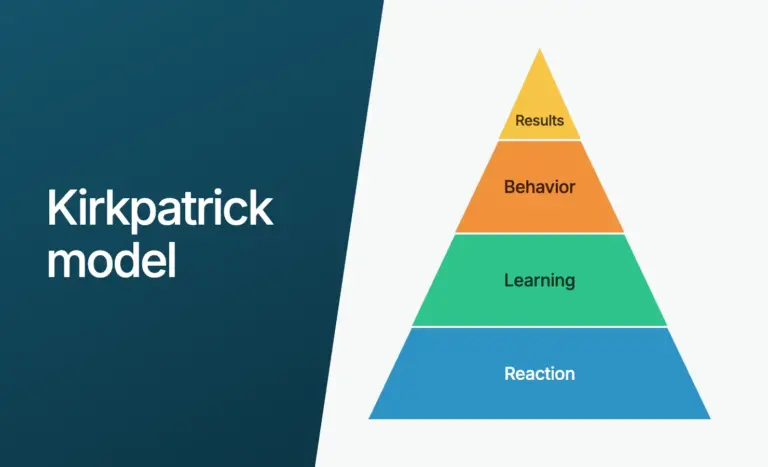
Most organizations invest in training but struggle to prove its value. Measuring training effectiveness requires tracking outcomes at four levels.
Level 1: Reaction. Did learners find the training useful? Collect feedback through post-training surveys. Low satisfaction scores signal content or delivery problems.
Level 2: Learning. Did learners gain knowledge? Use quizzes, assessments, and practical exercises to test what was learned. Compare pre-training and post-training scores.
Level 3: Behavior. Are learners applying what they learned on the job? This requires manager observation, performance reviews, and tracking of key work metrics over 30 to 90 days after training.
Level 4: Results. Did training improve business outcomes? Track metrics like reduced error rates, faster onboarding, higher sales, lower attrition, and fewer compliance violations. An employee training management software with built-in analytics makes this tracking practical. You can review the full range of LMS features for training including dashboards, completion reports, and assessment analytics.
How LMS Software Simplifies Employee Training
Managing training through spreadsheets, email reminders, and shared folders does not scale. When your organization grows beyond 50 employees or operates across multiple locations, you need a system. This is where LMS software becomes essential.
A cloud-based enterprise learning management system centralizes all training content in one platform. It assigns courses automatically based on roles, departments, or locations. It tracks who completed what and when. It sends reminders to employees who fall behind. It generates certificates as proof of training for compliance audits.
For Indian organizations using a SaaS LMS, the benefits go further. Employees access training from any device. Managers see real-time progress dashboards. HR teams generate audit-ready reports without manual data collection. And when regulations change, updated content reaches every employee across every office within hours.
Customer Training as a Growth Strategy
Employee training is only half the picture. Smart companies also train their customers.
Customer training teaches your users how to get the most value from your product or service. It reduces support tickets. It improves product adoption. It increases renewal rates. And it builds loyalty. A Thought Industries study found that companies with customer education programs see 6.2% higher retention rates.
A customer training LMS lets you create self-paced courses, product walkthroughs, certification programs, and knowledge bases that customers access on their own. This scales your customer success team without adding headcount. Organizations in SaaS, healthcare, manufacturing, and financial services use customer training to turn users into advocates. You can explore training solutions that support both employee and customer training from a single platform.
AlphaLearn as Your Employee Training Platform
AlphaLearn is an ISO 27001:2022 certified LMS software that supports over 500,000 learners across BFSI, healthcare, retail, manufacturing, and facility management. For employee training and development, AlphaLearn provides automated course assignment based on roles and departments. It sends reminders for incomplete training. It generates completion certificates for compliance records. It supports SCORM and xAPI content standards for interoperability. And it delivers AI-powered course recommendations to personalize learning paths. You can see how companies across industries use AlphaLearn through real-world training case studies.
Whether you are training 100 employees at a single office or 10,000 across ten cities, the same platform scales without adding headcount to your training team. You can start your free LMS trial to test AlphaLearn with your own training content.
Employee training and development in 2026 is a competitive advantage. The data is clear. Organizations that invest in structured training programs see higher profits, lower attrition, and stronger employee engagement. For Indian companies facing talent wars across every sector, the question is not whether to train. It is how fast you can build a training program that scales. A reliable cloud LMS like AlphaLearn gives you the system, the tracking, and the consistency to make training a measurable business driver.
Arjun Mehta
HR Technology Consultant
Arjun advises mid-size and enterprise teams on LMS selection, HR tech integration, and digital learning transformation. He has helped 40+ organisations deploy AlphaLearn across India and the Middle East.
Get Started
See AlphaLearn in action
500,000+ employees trained. ISO 27001:2022 certified.