There is no single best training method. There is only the right method for the audience, the topic, and the outcome required. A branch-safety refresher for a warehouse night shift, a leadership workshop for regional managers, and a POSH compliance certification for a 5,000-person workforce all need different treatment – and applying the same delivery format to all three is one of the most common reasons corporate training budgets under-perform. A LinkedIn Learning 2024 Workplace Learning Report found that 89% of L&D professionals agree proactively building employee skills is important to navigating the changing future of work, yet fewer than half report having a defined method-selection process. Most teams default to whatever format they used last time, not the format the objective demands.
This guide walks through the twelve training methods most Indian enterprises actually use in 2026, what each is good and bad at, and how a modern LMS lets you combine them into one blended programme without adding administrative overhead.
How to think about training methods
Before picking a method, decide three things: what the learner needs to know or do, how quickly they need to be competent, and where they will actually be when the moment of application arrives. A frontline worker on a night shift in a warehouse does not need the same delivery as a manager preparing for a promotion. The wrong method turns good content into wasted budget – a 90-minute instructor-led session for a topic that needed a 5-minute mobile refresher wastes both trainer time and learner attention. Treat method selection as a design decision, not a default preference.
The categories that follow are not mutually exclusive. A well-run programme combines methods across a learner’s journey – self-paced content for base knowledge, an ILT session for practice, on-the-job coaching for reinforcement, and an assessment inside the LMS to certify competence. That sequencing is what a modern L&D team means by blended learning, and research from the Association for Talent Development consistently shows blended approaches outperform any single method in both completion and retention.
The 12 employee training methods
1. Instructor-led training (ILT)
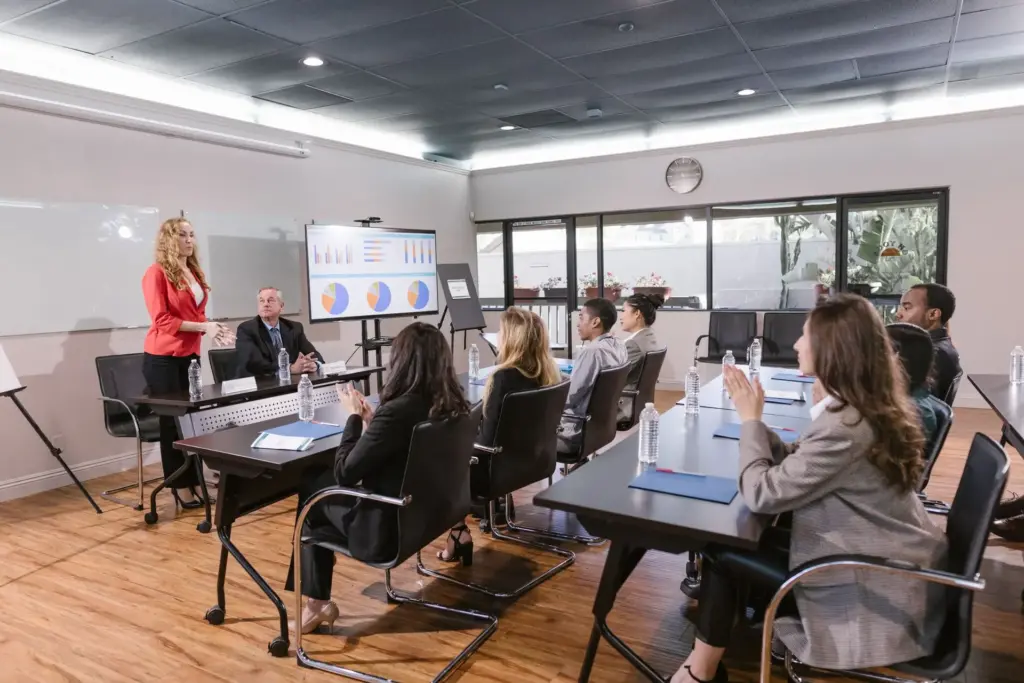
A classroom or workshop with a live instructor. Best for topics that need discussion, practice, or a shared experience – leadership development, negotiation skills, complex product training. The weakness is cost and scale: an ILT session reaches a room, not the whole workforce, and it is usually the first line item cut when travel budgets tighten. Use ILT where the interaction is the point, not because it is the default choice for every topic. Track attendance, feedback, and follow-up assessments through your LMS so the learning is not lost the moment the session ends.
2. Virtual instructor-led training (VILT)
The same live session, delivered on Zoom, Microsoft Teams, or an LMS webinar module. Preserves most of ILT’s interactivity while removing travel cost and reaching multiple branch locations simultaneously – a meaningful advantage for enterprises with operations spread across Tier 2 and Tier 3 Indian cities. Works well for product launches, policy updates, and cohort-based leadership programmes. The weakness is screen fatigue: sessions longer than 90 minutes lose attention sharply. Break long content into shorter live blocks with self-paced work between them.
3. Self-paced e-learning
Structured online courses that learners take on their own schedule. The workhorse of the enterprise LMS. Well suited to standard content that thousands of employees need at once – induction, product knowledge, code of conduct, DPDP Act 2023 awareness. The weakness is engagement if the content is a monotonous slide deck converted into a course; a well-designed course uses video, interaction, quick knowledge checks, and clear visual structure. Track completion, assessment scores, and time-on-task through the LMS reporting dashboard.
4. Microlearning
Short, focused content, typically two to seven minutes long, targeted at a single learning objective. Excellent for reinforcement, just-in-time performance support, and mobile-first delivery to frontline or field teams who cannot spare 45 minutes at a desk. Works well for product feature updates, SOP refreshers, and behavioural nudges. Not a substitute for a full course when the topic genuinely requires depth – a 4-minute video cannot replace a structured GMP certification path. Combine microlearning with self-paced e-learning rather than treating them as competing choices.
5. Video-based learning
Recorded video for demonstrations, expert interviews, or scenario-based content. Especially effective for skills that are inherently visual – a technique, a physical process, a difficult conversation – and for topics where an in-house subject-matter expert is more credible to the audience than a scripted, studio-produced course. The weakness is passivity: a video with no follow-up assessment produces recognition without demonstrated competence. Always pair video with a knowledge check inside the LMS.
6. SCORM and xAPI courses
SCORM is the packaging standard that lets a course built in one authoring tool run inside any SCORM-compliant LMS. It is the format most vendor-supplied compliance libraries ship in – POSH, GMP, ISO 27001, DPDP Act training. xAPI (Experience API) is the newer standard that also captures learning activity that happens outside the LMS itself, such as a simulation run in a separate application or informal learning tracked via a mobile app. Choose SCORM or xAPI depending on how much cross-system tracking the programme requires. Both formats are supported natively in AlphaLearn’s course engine.
7. On-the-job training (OJT)
Structured learning while doing the actual work, usually under a supervisor or a trained peer. The dominant method in manufacturing, retail, and field-service roles, and consistently one of the highest-transfer methods when it is done with structure. The weakness is inconsistency: without a written checklist, an OJT session reflects the trainer’s individual habits rather than a documented standard – a serious risk in regulated industries like pharma manufacturing, where GMP requires demonstrable, repeatable training records. Support OJT with a written task breakdown and a digital sign-off captured in the LMS so the compliance record exists and is auditable.
8. Coaching
One-to-one guidance from a more experienced colleague or an external coach, focused on the learner’s current, specific challenges. Suited to leadership development, high-performer growth plans, and situations where the learner needs to reflect on judgment rather than absorb new factual content. The weakness is scale and cost per head – coaching does not work as a mass-training method. Reserve it for populations where individual growth has a clear, measurable effect on business outcomes, and log objectives and outcomes in the LMS so the investment is visible to the business sponsor, consistent with a Kirkpatrick Level 3 and 4 measurement approach.
9. Mentoring
A longer-term developmental relationship, usually spanning organisational levels, focused on career growth and institutional know-how rather than specific tasks. Low-cost to run and consistently high-value for retention – Gallup’s workplace research links strong mentorship programmes to measurably lower attrition among high-potential employees. The weakness is fit: mismatched pairs disengage within weeks. Structure the pairing process deliberately, give both mentor and mentee a light conversational framework, and track the relationship’s activity – meeting cadence, not content – in the LMS.
10. Shadowing and job rotation
The learner observes or temporarily performs another role to build cross-functional context, cross-skill for flexibility, or prepare for an internal move. Effective for succession planning, cross-functional collaboration, and reducing single points of failure in critical operational roles. The weakness is disruption to the host role during the rotation period. Plan a defined rotation length, agree learning objectives up front, and capture a structured debrief in the LMS so the rotation counts as recorded development, not an informal break from regular duties.
11. Simulations and scenario-based learning
The learner works through a realistic scenario with consequences – a difficult customer conversation, a compliance decision under ambiguity, a safety response to an equipment failure. Strong on skill transfer because the practice closely resembles the actual job. The weakness is build cost: a well-designed simulation is significantly more expensive to author than a standard course. Reserve simulations for high-stakes topics where the cost of getting it wrong on the job – a safety incident, a compliance breach, a lost enterprise account – is far higher than the cost of building the scenario.
12. Gamification and cohort-based learning
Gamification adds points, levels, badges, and leaderboards to existing content to lift engagement and build a consistent learning habit. Cohort-based learning groups a defined set of employees who progress through a programme together, adding social accountability and peer support. Both work well for behavioural topics where the core challenge is motivation rather than information transfer. Gamification does not rescue content that was uninteresting to begin with – it amplifies whatever experience already exists, for better or worse. For a full breakdown of what works and what backfires, see our guide to gamification in an LMS.
Choosing the right method by objective
Match method to objective, not to habit. The table below is a starting framework; every enterprise adapts it to its own operational reality, workforce distribution, and compliance calendar.
| Objective | Primary method | Reinforcement |
|---|---|---|
| Onboarding for new joiners | Self-paced e-learning + short ILT | Microlearning + manager check-in |
| Compliance certification (POSH, DPDP, GMP) | SCORM course + assessment | Annual refresher + microlearning nudges |
| Product knowledge for sales | Self-paced modules + role-play VILT | Microlearning + coaching |
| Frontline safety and SOPs | Video + OJT sign-off | Microlearning on mobile |
| Leadership development | Cohort programme + ILT/VILT | Coaching + mentoring |
| Cross-functional skill build | Self-paced e-learning + shadowing | Simulation or project work |
How AlphaLearn delivers a blended training approach
AlphaLearn lets you combine every method above into a single learning path without extra administrative work. Self-paced modules, SCORM and xAPI-packaged compliance courses, ILT and VILT scheduling with automated attendance tracking, microlearning delivered on mobile in 12 Indian languages, gamification mechanics, and digital OJT sign-offs all sit inside one platform rather than across five disconnected tools. Role-based automation assigns the right blend of methods by job role automatically, and unified reporting rolls the mixed delivery up to a single completion and outcome view for the L&D team and business sponsors.
For sales enablement, that typically means self-paced product modules paired with VILT role-play and coaching follow-up. For compliance training, it means a SCORM-packaged course, an assessment, and an automated annual refresher cycle. For frontline and manufacturing teams, it means video content and OJT sign-offs reinforced through the AlphaLearn mobile app. Explore the full feature set or see how the approach scales for large workforces on the Enterprise LMS page, or visit the employee training software solution page for a role-based breakdown.
Key takeaways
- Training methods fall into four families: instructor-led, self-paced digital, on-the-job, and social or experiential.
- No single method is best – the right choice depends on the audience, the topic, and the outcome required.
- Most effective programmes blend three or four methods across a learner’s journey rather than relying on one.
- Match method to objective: compliance and product knowledge use different delivery from leadership development, and frontline safety training needs a different mix again.
- A modern LMS is what makes a blended approach practical at scale – it holds the whole mix of methods, records, and outcomes in one system rather than five disconnected tools.
Want to run every training method through a single platform? Book a demo of AlphaLearn, or start a free 14-day trial.
Frequently asked questions
What are the main types of employee training methods?
Employee training methods fall into four broad families. Instructor-led training covers classroom sessions and virtual instructor-led (VILT) delivery. Self-paced digital methods include e-learning courses, microlearning, video, and SCORM content. On-the-job methods include OJT, coaching, mentoring, and shadowing. Social and experiential methods include simulations, gamification, and cohort-based learning.
Which training method is most effective for corporate training?
There is no single most effective method – effectiveness depends entirely on the objective. Compliance and product knowledge are best delivered through self-paced e-learning with assessment. Leadership development typically needs a cohort programme with coaching. Frontline safety benefits from short video plus supervised on-the-job practice. Most Indian enterprises blend several methods rather than relying on one, particularly for topics with regulatory stakes such as POSH or GMP training.
What is the difference between ILT and VILT?
Instructor-led training (ILT) is a live session delivered in person, usually in a classroom or workshop. Virtual instructor-led training (VILT) delivers the same live session online through platforms such as Zoom, Microsoft Teams, or an LMS webinar module. VILT preserves most of the interactivity of ILT while removing travel cost and reaching multiple locations simultaneously, but works best when sessions are kept under 90 minutes to avoid screen fatigue.
What is blended learning?
Blended learning combines two or more training methods in a single programme – typically self-paced e-learning for base knowledge, live sessions (ILT or VILT) for practice and discussion, and on-the-job or coaching support for reinforcement. It is the most common approach in Indian enterprises because it balances scale, engagement, and transfer to the job better than any single method used alone.
How do I choose the right training method?
Start with the outcome, not the method. Decide what the learner should be able to do after training, how quickly they need to be competent, and where the moment of application will happen. Then pick the method – or blend of methods – that best matches those constraints. High-stakes or complex skills usually need a blend of self-paced content, live practice, and on-the-job support, while low-stakes, high-volume topics like induction or code-of-conduct refreshers are usually best served by self-paced e-learning alone.
Neha Iyer
Learning Experience Designer
Neha specialises in eLearning design, blended learning models, and learner engagement strategy. She brings a learner-first perspective to instructional design, with a focus on mobile-first delivery for deskless workforces.
Get Started
See AlphaLearn in action
500,000+ employees trained. ISO 27001:2022 certified.