Gamification is the most over-sold feature in the LMS market. Vendors show badges and leaderboards on every screenshot; buyers switch them on and wonder why completion did not budge. A 2023 TalentLMS survey found that 89% of employees say gamification makes them more productive at work – yet L&D teams consistently report that completion rates barely move after switching on points and badges. The gap between expectation and outcome is not a gamification problem. It is a design problem: gamification applied as decoration instead of as behaviour design.
This guide explains the difference, shows the mechanics that reliably work in Indian enterprise training, and flags the ones that quietly backfire.
What gamification in an LMS actually is
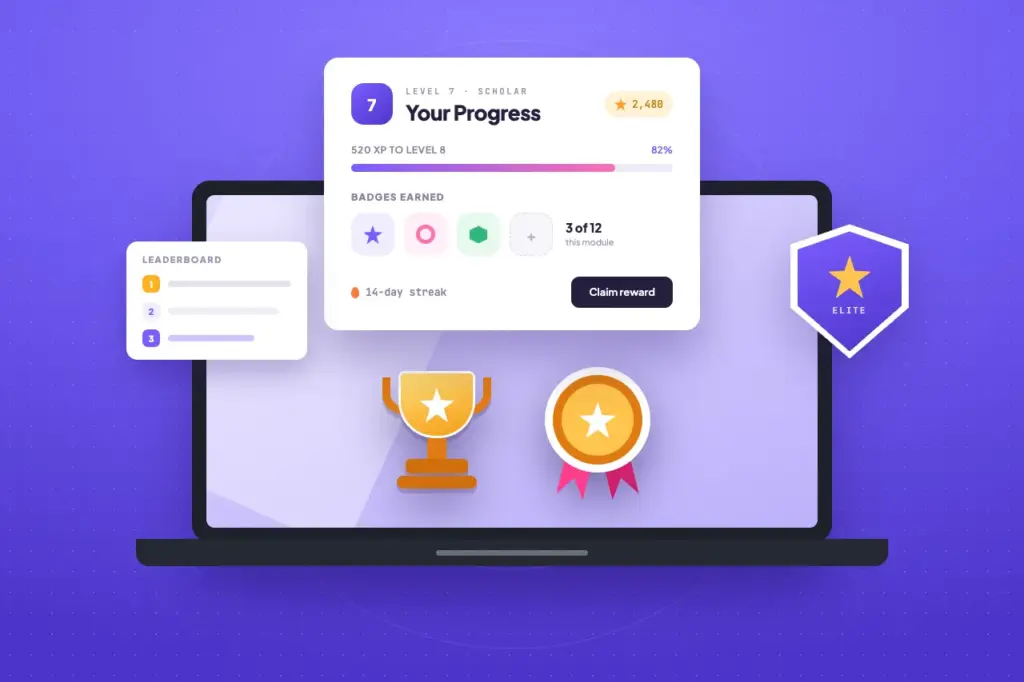
Gamification is the deliberate application of game mechanics to non-game contexts to change specific behaviours. In a learning management system, the target behaviours are usually: starting a course, returning the next day, completing what was started, and applying what was learned on the job. The mechanics are borrowed from games because games are unusually effective at getting people to persist through difficulty. Points, progress bars, levels, badges, streaks, quests, and leaderboards all make progress visible and make effort feel rewarded.
Gamification is not the same as game-based learning. Game-based learning uses actual games – simulations, branching scenarios, serious games – as the training content itself. Gamification wraps mechanics around ordinary training content. The two can coexist in the same LMS platform, but they are different design decisions addressing different problems.
For frontline workforces in India – where training has historically been infrequent classroom sessions – game mechanics also serve as an engagement bridge. A visible progress bar and a daily streak make the habit of opening a training app less intimidating than staring at a 45-minute module with no visible structure or feedback.
Why gamification lifts training outcomes
The behavioural science behind gamification is well established. B.J. Fogg’s Behaviour Model identifies three components required for any behaviour to occur: sufficient motivation, sufficient ability, and a timely prompt. Gamification works by strengthening all three. Points and progress bars increase motivation by making progress visible. Microlearning modules and daily quests lower the ability barrier by reducing perceived effort. Push notifications and streak reminders are the prompt.
Well-designed gamification changes three learner behaviours that matter directly to L&D outcomes:
- Starting: a clear progression and a small early reward – a “day one” badge, the first 50 points – reduces the friction of opening the first module. First-module completion is the strongest predictor of overall course completion.
- Continuing: streaks, progress bars, and level thresholds pull learners back the day after. According to Duolingo’s internal research (widely cited in the learning design field), a 7-day streak increases 30-day retention by over 2.4x compared to learners with no streak.
- Finishing: a visible endpoint and a completion reward – badge, certificate, points milestone – reduces the drop-off that typically happens in the final 20% of a course, which is where most corporate training loses learners.
None of this is manipulation. It is the same set of cues a well-designed curriculum, textbook, or coach uses. The LMS makes those cues consistent, visible, and hard to miss for every learner simultaneously.
The gamification mechanics that work in enterprise LMS
Not every game mechanic transfers cleanly to corporate training. These four consistently do across Indian enterprise L&D programmes:
| Mechanic | What it does | Best for |
|---|---|---|
| Points and XP | Assigns a value to every learning action – module completion, quiz score, time spent. Makes cumulative effort visible. | Rewarding learning depth, not just clicks. Assign more points for high-scoring assessments than for simply opening a module. |
| Progress bars and levels | Show where a learner is in a course or path, and what the next threshold looks like. Reduce ambiguity about how far they have to go. | Long courses, multi-week onboarding programmes, certification paths. The Zeigarnik effect – the tendency to remember and return to unfinished tasks – works strongly here. |
| Badges and certificates | Signal a meaningful achievement to the learner, their manager, and their profile. Provide social proof of competence. | Skills certifications, compliance completions (POSH, GMP, RBI), specialisations. Badges work best when they require genuine effort – not just presence. |
| Streaks and daily quests | Build a learning habit through small, daily wins. A 3-minute daily quiz or a micromodule maintains momentum between longer training blocks. | Sales enablement, microlearning reinforcement, frontline upskilling on the mobile app. Particularly effective for distributed workforces who cannot do long sessions. |
Layer them thoughtfully. A course with points, a progress bar, a badge on completion, and a streak that pulls learners back the next day is a well-gamified course. A course with all of those plus a leaderboard, a boss level, and a virtual currency is a novelty experiment that will not survive the first quarter.
Leaderboards: the mechanic most often broken
Leaderboards work in sales training because sales already runs on rankings – top performer lists, monthly targets, branch-level competition. They work poorly in almost every other enterprise context, and often backfire badly.
The bottom of a public leaderboard demotivates the people training was meant to reach most. The top of it turns collaborative teams into competitors. In Indian enterprises – particularly in manufacturing, healthcare, and BFSI operations – public individual rankings can conflict with collectivist workplace cultures where being singled out, even positively, creates discomfort.
Three design choices decide whether a leaderboard helps or hurts:
- Peer group size: a leaderboard among 500 learners is discouraging for 490 of them. Among 5 to 10 peers – a branch, a team, a cohort – it is motivating and contextually fair.
- What is ranked: rank on effort or improvement, not absolute score. A new joiner improving fastest should be able to top the board. Ranking purely on total points rewards those who started earliest, not those learning hardest.
- Visibility: opt-in leaderboards for those who want competitive context; private by default for everyone else. Compliance training leaderboards are almost always a mistake – nobody wants to be publicly last on POSH awareness.
If you do not control all three of those variables in your LMS configuration, consider not using a leaderboard at all for that programme.
Rewards: why intrinsic beats extrinsic (most of the time)
The self-determination theory – developed by psychologists Edward Deci and Richard Ryan – provides the research foundation: intrinsic motivation (autonomy, mastery, purpose) produces more durable behaviour change than external rewards. The strongest evidence base in behavioural science consistently shows that extrinsic rewards – vouchers, cash, prizes – lift short-term participation and then flatten motivation once they are withdrawn. Worse, they can undermine intrinsic motivation if learners start to associate training with the reward rather than the learning itself.
That does not mean prizes never work in an enterprise LMS. It means: use them sparingly and specifically for the one-off behaviours that need a push – an annual compliance certification deadline, a product launch quiz, a safety certification drive. For everyday learning habits, invest in progress visibility and recognition. Skip the prize budget.
When gamification backfires
Five design mistakes reliably turn gamification from a lever into a drag:
- Rewarding clicks, not learning: points for opening a module – regardless of score or time spent – encourage skimming and produce a completion figure that does not represent competence. Design point systems so a high assessment score earns significantly more than just showing up.
- Public leaderboards for compliance training: nobody wants to be publicly last on POSH awareness or fire safety. Keep leaderboards where competition is culturally appropriate – primarily sales and certain customer service contexts.
- Novelty without content quality: a well-gamified bad course is still a bad course. Fix the content before adding mechanics. Gamification amplifies whatever the training experience already is.
- Badges for everything: if every learner earns every badge, badges signal nothing. Reserve them for meaningful thresholds – completing a certification path, achieving a high assessment score, maintaining a 30-day streak. Scarcity is what gives badges their motivational value.
- Unclear rules: if learners cannot see how points are earned or what the next level threshold is, the mechanics feel arbitrary and lose their pull entirely. Every mechanic must be transparent and immediately understandable.
Where gamification fits by use case
Not every training programme benefits from the same mechanics. Applying the same gamification template to compliance training and sales enablement is as mistaken as using the same course for both. This table shows what works where:
| Use case | What to gamify | What to avoid |
|---|---|---|
| Onboarding | Progress bar, day-one badge, week-one streak. Make the first 30 days feel structured and achievable. | Public leaderboards – new joiners feel exposed and unfairly compared to established employees. |
| Compliance training (POSH, GMP, RBI) | Progress bar, completion badge, digital certificate. Make mandatory completion visible and acknowledged. | Points and leaderboards. Compliance training signals an obligation that must be met by everyone – competition undermines that message. |
| Sales enablement | Points, team leaderboards, daily streaks, product knowledge quizzes with instant scores. Sales teams respond to rankings. | Long badge quests. Sales attention spans are short – daily quick wins outperform multi-week achievement paths. |
| Product knowledge refresh | Daily microlearning streaks, quiz points, completion badges for each product family. | Complex level systems. A product refresh is a sprint, not a game – keep mechanics simple. |
| Frontline safety training | Simple team badges, shift-level completion tracking. Collective achievement motivates better than individual ranking. | Individual public ranking. In factory and warehouse settings, individual safety rankings create blame culture rather than safety culture. |
| Leadership development | Cohort progress milestones, peer recognition features, programme completion badges. | Points and prizes. Out of tone with a senior audience; undermines the seriousness of the development programme. |
How to design gamification for your LMS: 5 steps
Step 1. Start with the behaviour you want. Name the specific behaviour that matters – starting the course within 48 hours of assignment, completing weekly, scoring above 80% on the assessment, returning the next day. Mechanics follow the behaviour you are targeting, not the other way round. “We want to add gamification” is not a design brief. “We want to close the first-module drop-off gap” is.
Step 2. Pick two or three mechanics, not seven. The most effective gamified courses use points plus a progress bar plus one signalling reward – a badge or certificate. Each additional mechanic dilutes the signal and increases the cognitive load on the learner. Restraint is a design skill.
Step 3. Design for meaning, not for volume. One badge that requires genuine effort – completing all five modules of a POSH certification path with a pass score – is worth more than ten badges for opening modules. Fewer, harder-to-earn rewards are consistently more motivating than many easy ones. This is well documented in the gamification design literature and in the operational data from large enterprise deployments.
Step 4. Test the leaderboard before you publish it. Before making any leaderboard visible, ask: would being at the bottom of this board embarrass or demotivate the learner it is supposed to reach? Would it divide the team? If yes, the leaderboard is not the right mechanic. Choose a smaller peer group, rank on improvement rather than absolute score, or drop it.
Step 5. Measure the actual outcome. Track whether starting, continuing, and finishing rates changed after gamification was switched on – and whether performance on post-training assessments or on-the-job behaviour moved. Novelty always shows up in the first month as a spike. Sustained lift three months later is the real test of whether the design worked.
Gamification in AlphaLearn
AlphaLearn gives L&D teams the full set of gamification mechanics – points, levels, badges, leaderboards, quests, streaks, and a rewards store. The design guardrails are built in. Leaderboards can be scoped to peer groups rather than the whole organisation, ranked on improvement rather than absolute score, and configured as opt-in rather than mandatory. Badges can be tied to competency thresholds and assessment scores, not just module completion. Streaks and daily quests work particularly well on the AlphaLearn mobile app for reinforcing microlearning for frontline and sales teams across 12 Indian languages.
For sales teams, AlphaLearn’s gamification drives product knowledge completion and new hire ramp-up speed. For compliance training programmes – POSH, DPDP Act 2023, GMP, RBI – it drives on-time completion without the leaderboard and points mechanics that undermine seriousness. For employee onboarding, structured progress bars and day-one badges make the first week feel achievable rather than overwhelming.
To see the full range of LMS features, including gamification configuration options, visit the features page. For large-organisation deployment, see the enterprise LMS page.
Key takeaways
- Gamification changes the behaviours that matter – starting, continuing, finishing – when mechanics are designed around a specific behaviour, not switched on as decoration.
- The four mechanics that consistently work in enterprise LMS are points, progress bars, badges, and streaks. Leaderboards work only in specific contexts – primarily sales – and backfire almost everywhere else.
- Intrinsic rewards – progress, mastery, recognition – build durable engagement. Extrinsic rewards (prizes, vouchers) lift the short term and then flatten. Use them sparingly and for specific one-off pushes.
- Fewer, harder-to-earn rewards signal more than many easy ones. If every learner earns every badge, badges mean nothing.
- In Indian enterprise contexts, individual public ranking conflicts with collectivist workplace cultures in manufacturing, healthcare, and BFSI. Design for team achievement and opt-in competition wherever possible.
- Two or three well-chosen mechanics almost always beat six or seven layered together. Restraint is a feature.
Want gamification that lifts real behaviour, not just click-through rates? Book a demo of AlphaLearn, or start a free 14-day trial.
Frequently asked questions
What is gamification in an LMS?
Gamification in a learning management system is the use of game-style mechanics – points, levels, badges, leaderboards, quests, and streaks – to motivate learners to start, complete, and apply training. It is applied to ordinary training content, not the content itself. A gamified compliance course is still a compliance course; the mechanics wrap around it to change the likelihood that learners engage with it seriously and return to complete it.
Does gamification actually improve learning outcomes?
Yes, when designed around behaviour rather than novelty. A 2023 TalentLMS survey found that 89% of employees say gamification makes them more productive at work, and 88% say they are happier. Well-implemented gamification consistently lifts course starting rates, daily return rates, and overall completion. Its effect on genuine knowledge retention and on-the-job behaviour depends on whether mechanics reward learning depth or just clicks. Rewarding clicks produces completion figures without a matching change in competence.
Are leaderboards a good idea for corporate training?
Leaderboards work well where competition is culturally appropriate – notably sales training, certain customer service contexts, and teams that already operate with rankings. They backfire in compliance training, safety training, onboarding, and most collaborative team contexts. The bottom of a public leaderboard actively demotivates the learners training was designed to reach. If used, scope leaderboards to small peer groups (5-10 people), rank on improvement rather than absolute score, and make them opt-in rather than default-visible.
What game mechanics work best for compliance training in India?
For compliance training – POSH Act, DPDP Act 2023, GMP, RBI/IRDAI, Factories Act safety – the effective mechanics are a progress bar, a completion badge, and a digital certificate. These make mandatory completion visible and acknowledged without introducing competition. Points and public leaderboards are best avoided: they can undermine the seriousness of a compliance topic and create the wrong signal that compliance is optional or a competition rather than a universal obligation.
How much gamification is too much?
Two or three well-chosen mechanics almost always beat six or seven layered together. The most effective gamified courses combine points with a progress bar and one signalling reward – a badge or certificate. Adding leaderboards, virtual currencies, boss levels, and prize stores on top of that dilutes the motivational signal, creates novelty that fades within 4-6 weeks, and gives learners too many competing cues about what the training is actually for. Design restraint is a feature, not a limitation.
Arjun Mehta
HR Technology Consultant
Arjun advises mid-size and enterprise teams on LMS selection, HR tech integration, and digital learning transformation. He has helped 40+ organisations deploy AlphaLearn across India and the Middle East.
Get Started
See AlphaLearn in action
500,000+ employees trained. ISO 27001:2022 certified.