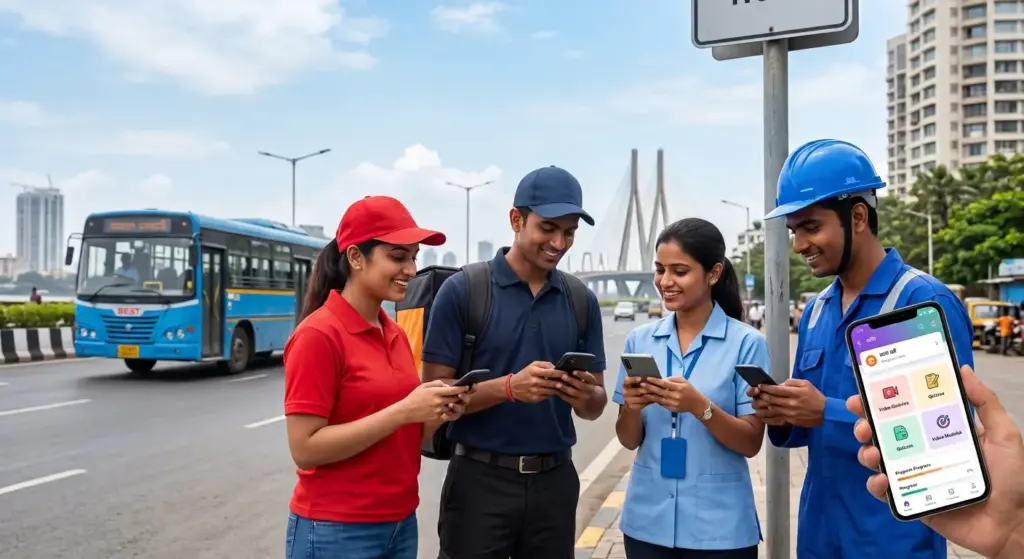
A large share of India’s workforce does not sit at a desk. According to McKinsey Global Institute estimates, over 80 percent of India’s working population is in deskless or frontline roles – store staff, factory operators, delivery riders, field sales teams, bank branch employees, healthcare workers. They rarely open a laptop during a shift, but they still need onboarding, product knowledge, safety training and compliance certification. A mobile LMS is how you reach them.
This guide explains what a mobile LMS is, why India’s frontline workforce specifically needs one, the features that matter for deskless teams, how it maps to key industries, and how to evaluate a mobile learning management system that frontline workers will actually use rather than ignore.
What is a Mobile LMS?
A mobile LMS is a learning management system designed to deliver training primarily on smartphones, through a dedicated native app or a fully responsive web experience built for small screens. The distinction matters: a desktop LMS with a responsive layout is not the same as a mobile-first platform. A true mobile LMS is engineered around how frontline staff actually work – in short windows of time, often without a reliable data connection, on mid-range Android handsets that are personal rather than company-issued.
In practice this means short lessons that complete in under five minutes, content available offline so a factory floor or remote field location with patchy connectivity is not a barrier, push notifications that reach workers who never open a work email, and an interface simple enough to use without training. For deskless teams, the phone is not a secondary device – it is the only practical channel for delivering structured training at scale.
Why India’s Deskless Workforce Needs Mobile Learning
India’s frontline workforce is vast, geographically distributed, and linguistically diverse. Consider the scale: a mid-sized FMCG company may have 20,000 store promoters spread across 15 states speaking 8 languages. A logistics company may have 50,000 delivery riders across tier-2 and tier-3 cities. A private sector bank may have 10,000 branch staff and 5,000 field sales executives who are never at a desk. Classroom training cannot reach all of them affordably, and desktop eLearning was never designed for them.
Mobile learning solves the reach problem. Three factors make it particularly important for India specifically:
- Smartphone penetration: India had over 600 million smartphone users in 2025. Even frontline workers in tier-3 cities carry a mid-range Android phone. The infrastructure for mobile learning already exists in the workforce.
- Language diversity: A single enterprise training programme may need to reach workers in Hindi, Tamil, Telugu, Bengali, Marathi, Gujarati and Kannada. Mobile LMS platforms built for India support vernacular delivery natively; desktop eLearning catalogues rarely do.
- Compliance exposure: Regulators – the Factories Act inspectors, RBI and SEBI auditors, POSH Act committees – expect completion evidence for every employee, not just head-office staff. Mobile closes the last-mile gap that leaves frontline workers out of compliance reports.
Key Features of a Mobile LMS for Frontline Teams
Not every feature that matters on a desktop LMS matters equally on mobile. These are the capabilities that determine whether a mobile LMS actually works for deskless workers in India:
Native iOS and Android Apps with Offline Access
A browser-based experience dependent on connectivity is not enough for factory floors, construction sites, or field locations where 4G is unreliable. A mobile LMS needs native apps for both iOS and Android that let learners download course content over WiFi and complete it entirely offline, syncing progress automatically when connectivity returns. This is the single most important feature for manufacturing, logistics, and rural field teams.
Push Notifications
Frontline workers do not use a corporate email inbox. Push notifications sent directly to the learner’s phone drive completion rates that email reminders cannot match. The ability to send targeted reminders – by department, location, or pending deadline – is essential for compliance campaigns where every employee must complete a module by a specific date.
Microlearning
A five-minute lesson a store associate can complete during a shift break gets done. A forty-minute course they are expected to complete after their shift does not. Microlearning – short, focused modules covering one concept at a time – is the format that works for frontline staff. A mobile LMS built for deskless teams structures content accordingly, rather than simply repackaging desktop-format courses into a smaller screen.
Vernacular Content Delivery
Content in the learner’s first language drives comprehension and completion. A mobile LMS for India must support delivery in Hindi, Tamil, Telugu, Bengali, Marathi, Gujarati, Kannada, Odia, Punjabi, Malayalam, Assamese and Urdu – not as an add-on, but as a core capability. This is particularly critical for safety and compliance training, where a worker who misunderstands instructions in a second language represents a real risk, not just a training statistic.
Simple, App-Like Experience
A mobile LMS that requires a training session to use will not be used. The interface must be intuitive for a worker picking it up for the first time – minimal text entry, large touch targets, a familiar app-store-style experience, and a login flow that works on a personal phone. If a store associate or factory operator cannot complete their first module within ten minutes of installing the app, adoption will fail regardless of the quality of the content. See the full LMS features and the AlphaLearn mobile app for specifics on supported capabilities.
Lightweight for Entry-Level Devices and Low Bandwidth
Mid-range Android phones with 2-3 GB RAM and limited storage are the norm in India’s frontline workforce. A mobile LMS that performs well only on flagship devices or requires large downloads over a fast connection will not work in practice. The app must be small, fast, and designed for the hardware your workers actually carry.
Mobile Learning Use Cases by Industry
The pattern is consistent across sectors: large, geographically distributed, multilingual workforces where the phone is the only practical training channel. In each case, mobile learning is not a convenience – it is the difference between training that reaches every worker and training that reaches only head-office staff.
| Industry | Mobile Training Need | Key Compliance Requirement |
|---|---|---|
| Retail and FMCG | Rapid onboarding, product knowledge, service standards across stores | POSH Act, food safety (FSSAI), anti-bribery |
| Manufacturing | Factory safety, SOPs, equipment operation and GMP on the shop floor | Factories Act, GMP (Schedule M), fire safety |
| Logistics and Transport | Route safety, defensive driving, process training for drivers and field staff | Motor Vehicles Act, dangerous goods handling |
| BFSI | Branch onboarding, product certification, AML and KYC for field teams | RBI guidelines, SEBI regulations, POSH Act |
| Healthcare | Clinical protocol refreshers, infection control, biomedical waste handling | NABH standards, Bio-Medical Waste Rules |
| Pharma | GMP refreshers, cold chain SOPs, field force product training | Schedule M (GMP), Drugs and Cosmetics Act |
For sector-specific compliance requirements, see the guides for LMS for BFSI, LMS for manufacturing, and LMS for pharmaceutical. Our employee training software overview covers how these use cases connect across industries.
Mobile LMS vs Desktop LMS vs Classroom Training
Understanding where mobile learning fits relative to other training formats helps L&D teams make the right decision about which approach to use for which audience.
| Factor | Mobile LMS | Desktop LMS | Classroom Training |
|---|---|---|---|
| Reach | Every employee with a smartphone | Desk-based staff only | Limited by venue and trainer availability |
| Scalability | Scales to 50,000+ learners instantly | Scales but excludes frontline | Expensive and slow to scale |
| Offline access | Yes – native app download | No – requires internet connection | Not applicable |
| Vernacular support | 12 Indian languages | Varies by platform | Depends on trainer |
| Compliance reporting | Automated, audit-ready for all staff | Automated but limited to desk users | Manual attendance sheets |
| Cost per learner | Low once platform is in place | Low once platform is in place | High – venue, travel, trainer time |
Mobile Learning, Compliance and Audit Readiness
Compliance is where mobile learning earns its place fastest in Indian enterprises. Mandatory training – POSH Act, factory safety, fire drills, code of conduct, AML awareness – applies to every employee by law. In practice, head-office staff complete it through a desktop LMS while frontline workers are missed because the training was never designed to reach their device. That gap is exactly what auditors and regulators look for.
An SEBI inspection, an RBI compliance audit, a Factories Act inspection, or a POSH committee review will ask for completion evidence for the entire workforce, not just the employees who sit at computers. A mobile LMS closes this gap. You assign a POSH or safety module to every store, plant and branch worker, send push reminders until it is done, and produce an audit-ready report showing completion by department, location and date for every employee in the organisation.
For regulated Indian sectors, mobile is not a convenience – it is how you make compliance training legally complete. For more detail on compliance-specific LMS requirements, see the compliance training guide.
Benefits of a Mobile LMS
The benefits flow from solving the reach problem that desktop eLearning cannot:
- Reach workers desktop eLearning misses: A mobile LMS is the only way to deliver structured training to 80 percent of India’s workforce at scale. Without it, your training programme effectively excludes your frontline.
- Higher completion rates: A five-minute lesson during a shift break gets done. Push reminders on a personal device work better than emails to a corporate inbox that frontline workers rarely check. Completion rates for mobile-delivered compliance campaigns consistently outperform desktop alternatives for frontline audiences.
- Lower cost than classroom: Classroom training for 10,000 store staff across 500 locations involves venue costs, trainer travel, lost productive time and weeks of scheduling. Mobile training delivers the same content in the same week at a fraction of the cost.
- Better comprehension through vernacular delivery: A worker who trains in their first language retains more and applies it more reliably. This matters especially for safety and compliance content where misunderstanding has real consequences.
- Complete compliance evidence: Automated completion tracking for every employee, exportable in audit-ready format, covering the entire workforce including frontline – not just desk-based staff.
How to Choose a Mobile LMS for India
These are the practical evaluation criteria that separate a genuine mobile LMS from a desktop platform with a responsive stylesheet:
- Genuine offline support: Test it in airplane mode. Confirm content downloads, plays fully offline, and syncs on reconnection. Ask the vendor which content types work offline (video, SCORM, assessments) and which do not.
- Native apps, not just mobile web: A mobile browser experience has limitations around push notifications, offline storage, and performance. Native iOS and Android apps are the baseline for a serious frontline deployment.
- Vernacular language count: Ask for the specific list of supported languages, not just “multiple Indian languages”. For most Indian enterprises, a minimum of 8 Indian languages is necessary to cover the major regional populations.
- App size and device compatibility: Ask for the minimum Android version and RAM required. Test on a mid-range device (Rs. 8,000-12,000 price range), not just on the demo phone the vendor provides.
- Admin tracking for mobile learners: Confirm that managers and L&D admins can view completion, scores and time-spent for mobile learners with the same granularity as desktop learners – not just an aggregate count.
- Data residency and DPDP compliance: Frontline workers’ training data sits on personal devices and on vendor servers. Confirm AWS or Azure hosting in India (ap-south-1 or equivalent), ISO 27001:2022 certification, and a DPDP Act 2023-compliant Data Processing Agreement.
- Test adoption before signing: Put the app in the hands of 20-30 actual frontline workers – not head-office staff – before committing. If a store associate or factory operator cannot install the app, log in and complete their first module without assistance, adoption will fail at scale regardless of what the vendor demo showed.
How AlphaLearn Fits
AlphaLearn is mobile-first and built specifically for India’s frontline. Native iOS and Android apps deliver offline access, push notifications and microlearning in 12 Indian languages – so retail, manufacturing and logistics teams train on the device they already carry. The platform is hosted on AWS Mumbai (ap-south-1) for DPDP Act 2023 compliance and is ISO 27001:2022 certified. Explore the full feature set, read about the AlphaLearn mobile app, or request a demo to see mobile training in action with your own content. You can also start a free trial and put the app in front of a group of your frontline workers before you commit.
Frequently Asked Questions: Mobile LMS
What is a mobile LMS?
A mobile LMS is a learning management system built to deliver training primarily on smartphones, through a dedicated native app or a fully responsive experience. It is designed for how frontline staff work – short lessons, offline access, push reminders and content in the learner’s language – so deskless teams can train on the device they already carry rather than needing access to a laptop or desktop computer.
Why is mobile learning important for India’s workforce?
Over 80 percent of India’s working population is in deskless or frontline roles – store staff, factory operators, delivery riders, field sales teams. Classroom training is slow and expensive to scale to them, and desktop eLearning was not designed for workers who never sit at a computer. Mobile learning puts onboarding, safety and compliance training in every worker’s hands, in their language, on the device they already use.
Does a mobile LMS work offline?
A genuine mobile LMS lets learners download course content over WiFi and complete it without a connection, syncing progress automatically when they are back online. This offline capability is essential for shop floors, factories, construction sites and field locations across India where 4G connectivity is unreliable. Not all mobile-responsive LMS platforms support true offline access – test it explicitly before committing to a platform.
Can a mobile LMS deliver training in Indian languages?
Yes. A mobile LMS built for India delivers content in Hindi, Tamil, Telugu, Bengali, Marathi, Gujarati, Kannada, Odia, Punjabi, Malayalam, Assamese and Urdu. Vernacular delivery is one of the biggest drivers of completion and comprehension among frontline staff – a worker who trains in their first language retains more and applies it more reliably than one who trains in a second language. AlphaLearn supports all 12 of these languages.
What industries benefit most from a mobile LMS?
Industries with large, distributed, deskless workforces benefit most: retail and FMCG (store staff, promoters), manufacturing (factory floor operators, supervisors), logistics and transport (drivers, field staff), BFSI (branch and field sales teams) and healthcare (clinical and support staff). In each case, the phone is the only practical channel to deliver onboarding, product knowledge, safety and compliance training to the entire workforce at scale.
How is a mobile LMS different from a regular LMS?
A regular desktop LMS is designed for office-based staff with reliable internet access and a laptop or desktop computer. A mobile LMS is built for smartphones, with native apps, offline content download, push notifications, microlearning, and vernacular content. The critical difference is reach: a desktop LMS covers 20 percent of a typical Indian enterprise’s workforce; a mobile LMS covers the remaining 80 percent who work on the floor, in the field or across distributed locations.
How does a mobile LMS help with compliance in India?
Indian regulations – the POSH Act, Factories Act, RBI and SEBI guidelines, GMP under Schedule M – require completion evidence for every employee, including frontline workers. A mobile LMS assigns mandatory modules to every worker regardless of location, sends push reminders until completion, and generates audit-ready reports showing completion by department, location and date. This closes the compliance gap that leaves frontline workers out of the evidence trail a desktop-only system produces.
What should I look for when choosing a mobile LMS for India?
Prioritise genuine offline support (test it in airplane mode), native iOS and Android apps, support for at least 8 Indian languages, lightweight performance on mid-range Android devices, and admin dashboards that track mobile learners as precisely as desktop users. Confirm data hosting within India (AWS Mumbai or equivalent), ISO 27001:2022 certification, and a DPDP Act 2023-compliant Data Processing Agreement. Finally, test adoption with 20-30 actual frontline workers before committing – if a store associate cannot complete their first module without help, the platform will not scale.
Priya Sharma
L&D Specialist
Priya has 9 years of experience designing corporate training programmes for BFSI and retail organisations across India. She specialises in onboarding, soft skills, and building learning cultures that actually stick.
Get Started
See AlphaLearn in action
500,000+ employees trained. ISO 27001:2022 certified.