Training without assessment is just content consumption. You cannot prove someone learned anything until you test it — and in regulated industries you cannot prove compliance until you can show a valid, current certificate. Online assessment software and certification management are the two capabilities that turn training into verifiable proof of competency.
This guide explains both, how they work together inside an LMS, and how to choose them — with specific reference to India’s compliance landscape.
What is Online Assessment Software?
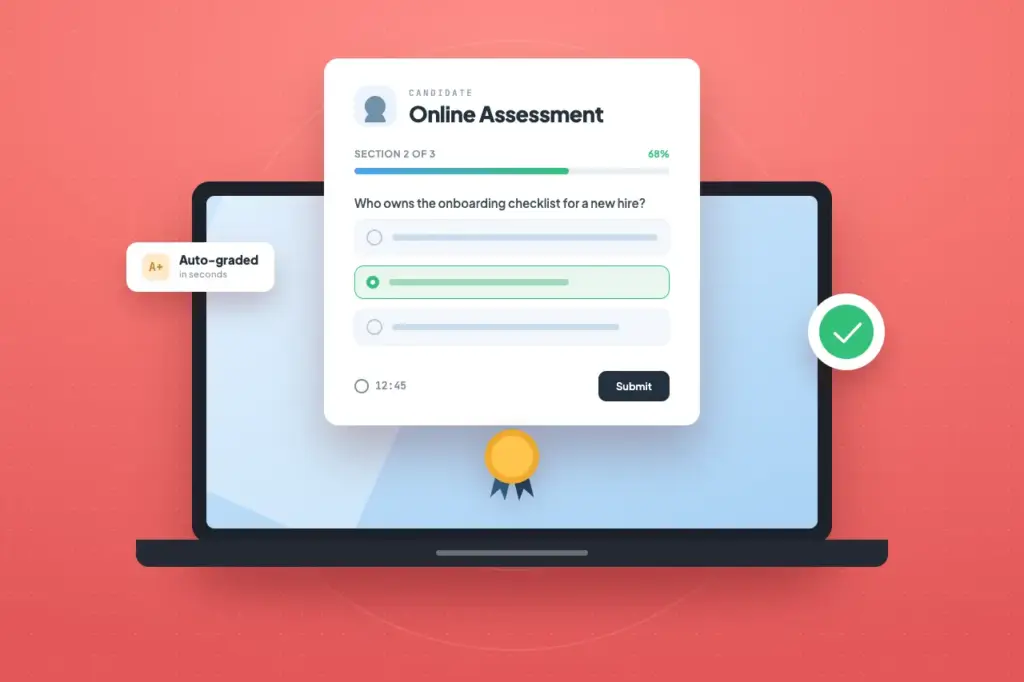
Online assessment software lets you create, deliver, and automatically grade quizzes and exams inside your learning platform. Rather than marking papers by hand, you configure the rules once — pass marks, time limits, retake policies — and the system scores every attempt and records the result. That data is the foundation of measuring whether training actually worked.
Modern LMS platforms embed assessment tools directly into the course flow. A learner completes a module, takes the quiz, and the result is recorded instantly — no manual intervention. For compliance training specifically, this automatic record is what makes the evidence trail defensible during an audit.
Types of Assessments in an LMS
A capable LMS assessment module supports multiple question formats, because different training objectives call for different testing approaches:
- Multiple-choice questions (MCQs) with configurable pass marks and time limits — the workhorse of compliance and product knowledge testing
- True/false and fill-in-the-blank questions for quick knowledge checks between modules
- Subjective questions for deeper, written responses — graded manually by an assessor or manager
- Scenario-based questions that test judgement, not just recall — particularly effective for POSH Act, code of conduct, and customer-handling training
- Randomised questions drawn from a large question bank, so no two learners receive the same paper — the most effective anti-cheating control in an online exam
Why Online Assessment Beats Paper-Based Testing
For organisations still running paper quizzes after classroom sessions, the gap in quality and utility is significant:
- Automatic grading — results are instant and consistent, with no manual marking or data entry
- Built-in integrity controls — timing, full-screen lock, and question randomisation are impossible on paper
- A permanent, searchable record — every attempt, score, and completion timestamp is stored and reportable; paper cannot match this for audit purposes
- Scale — assess thousands of learners across locations simultaneously, with no additional cost per candidate
- Direct link to certification — a passing score automatically triggers a branded digital certificate, closing the loop from training to proof of competency
Maintaining Assessment Integrity
For low-stakes knowledge checks, a simple quiz is sufficient. For compliance certification — POSH Act, RBI mandatory training, GMP qualification, NABH assessments — integrity controls matter. Proctoring features available in modern LMS platforms include:
- Timed assessments — a 30-minute window prevents looking up answers
- Full-screen lock — prevents switching to another tab or application during the exam
- Question randomisation from a question bank — every learner receives a unique paper drawn from a pool of 50 or 100 questions, making answer-sharing ineffective
- Retake rules — limit the number of attempts and enforce waiting periods between retakes
Generating a unique paper for each learner is one of the most effective safeguards available, and it is only practical at scale with software. AlphaLearn’s AI-powered question generator can build a question bank from your existing course content automatically — see the platform features for details.
Formative vs Summative Assessment
Not every assessment has the same job. Understanding the distinction shapes how you design your training programme:
| Type | Purpose | When used | Stakes |
|---|---|---|---|
| Formative | Check understanding during learning | During or between modules | Low — for learner feedback |
| Summative | Certify that a standard has been met | End of course or programme | High — triggers certification |
A strong compliance training programme uses both. Frequent formative checks reinforce retention throughout the learning path. A rigorous summative exam at the end certifies competency — and that summative result is what certification management builds on.
What is Certification Management?
Passing an assessment should produce something durable: a certificate. Certification management is the process of issuing, tracking, and renewing those certificates across your workforce. A capable system:
- Generates branded PDF certificates automatically on passing the summative assessment — no manual admin required
- Records the certificate date, expiry date, and score against each learner’s profile
- Sends expiry alerts before certifications lapse — typically 30, 60, and 90 days before expiry — so L&D teams and managers can act before a compliance gap opens
- Supports renewal workflows — automatically re-enrols employees in refresher courses as their certificates approach expiry
- Makes certificates verifiable — so a regulator, auditor, or client can confirm authenticity without contacting HR
In compliance-heavy sectors, the expiry and renewal side is just as important as the initial issue. A lapsed POSH Act certification is a compliance gap. A lapsed GMP qualification is a regulatory finding. Certification management prevents both by automating the renewal cycle.
QR-Verifiable Certificates
A modern refinement is the QR-verifiable certificate: every certificate carries a unique QR code that a regulator, auditor, or client can scan to confirm authenticity and currency instantly. It removes the possibility of forged certificates — a real concern in high-volume, distributed workforces — and makes third-party verification effortless during inspections or background checks.
QR verification works because the code links to a live record in the LMS. If a certificate has expired or been revoked, the scan returns that status immediately, not a stored PDF that may be out of date.
Assessments and Certification for Compliance in Indian Industries
In regulated Indian industries, assessments and certification management are your primary evidence base for regulatory inspections. The specific requirements by sector:
| Industry | Mandatory training requiring certification | Inspecting authority |
|---|---|---|
| BFSI | SEBI compliance, AMFI/NISM certification, IRDAI mandatory training, AML/KYC, POSH Act | RBI, SEBI, IRDAI |
| Pharmaceutical | GMP (Schedule M), GCP, CDSCO-aligned SOP training, DPDP Act | CDSCO, FDA inspectors |
| Manufacturing | Factory safety, fire safety, equipment operation, GMP (food/pharma), POSH Act | Factories Act inspector, BIS |
| Healthcare | NABH standards, infection control, Bio-Medical Waste Rules, POSH Act | NABH, state health departments |
| All sectors | POSH Act (Sexual Harassment of Women at Workplace Act, 2013) | Internal Complaints Committee, labour courts |
When an inspection lands, you export audit-ready evidence — completion records, assessment scores, certificate issue dates, and expiry status — in one click. This is central to the compliance training use case and especially critical in pharmaceutical and BFSI sectors where documentation is routinely scrutinised by regulators.
How Assessment Data Feeds Learning Analytics
Assessment results are not just pass/fail records — they are one of the richest signals in your training data. When aggregated across a workforce, scores reveal which topics are understood and which are not, exposing skill gaps that completion rate alone cannot surface.
Feeding assessment data into your LMS reporting turns individual results into organisational insight:
- Which modules have the highest failure rates — and therefore need to be redesigned
- Which departments have compliance coverage gaps, before an auditor finds them
- Which employees are ready for the next level of training or certification
- Trends over time — whether repeated training is actually improving scores, or whether the same knowledge gaps persist
For learning that happens beyond formal courses — simulations, on-the-job tasks, performance observations — the Experience API (xAPI), developed by the ADL Initiative and supported natively in modern LMS platforms, can capture assessment and performance data from these contexts too, giving a fuller picture of competency than quiz scores alone.
Best Practices for Writing Assessment Questions
The quality of your assessment questions determines whether you are measuring genuine competency or just the ability to complete a form. These principles apply whether you are writing a POSH Act quiz, a GMP knowledge check, or a product certification exam:
- Test application, not just recall. Scenario questions — “A colleague sends you an email asking you to share a customer’s account details. What do you do?” — reveal whether someone can actually use what they learned. MCQs that test definitions reveal only memory.
- Write clear, unambiguous stems. Avoid double negatives and trick wording. A question that tests reading comprehension rather than knowledge undermines the assessment’s validity.
- Build a large question bank. A bank of 60-80 questions for each compliance module allows randomisation to produce genuinely different papers. A bank of 15 questions does not — learners share answers quickly.
- Align every question to a learning objective. If a question does not map to something you taught and something learners must be able to do, remove it. Irrelevant questions dilute the signal.
- Set a defensible pass mark and consistent retake rules. For compliance certifications, the pass mark should reflect the standard required, not the pass rate you want. 70 percent is a common threshold; for high-risk training such as fire safety or GMP, 80 percent or higher is more defensible.
Choosing Assessment Software: Evaluation Checklist
When evaluating an LMS or standalone assessment tool for Indian enterprise use, these are the capabilities that matter:
- Range of question types — MCQ, true/false, fill-in-the-blank, subjective, and scenario-based
- Question banks with randomisation — to protect exam integrity at scale
- Proctoring controls — time limits, full-screen lock, retake rules
- Full certification lifecycle — auto-issue on pass, expiry tracking, renewal workflows, expiry alerts
- QR-verifiable certificates — for third-party verification by regulators and auditors
- Reporting that turns scores into skill-gap insight — not just pass/fail counts
- Audit-ready export — one-click report of completion, scores, and certificate status for regulatory submission
- AI-powered question generation — to build question banks from existing content quickly
- DPDP Act 2023 compliance and India data hosting — assessment data includes personally identifiable information and must meet Indian data protection requirements
Assessments and Certification in AlphaLearn
AlphaLearn includes the full assessment and certification toolkit in every plan. The specific capabilities:
- Configurable quizzes with MCQ, true/false, fill-in-the-blank, subjective, and scenario-based question types
- AI-powered question generator that builds a question bank from your course content automatically
- Randomised question banks so every learner receives a unique paper
- Proctoring controls: timed assessments, full-screen lock, configurable retake rules
- Auto-generated branded PDF certificates on passing — no admin intervention required
- Certificate expiry tracking and automated renewal reminders at 90, 60, and 30 days
- QR-verifiable certificates that regulators and auditors can scan to confirm authenticity in real time
- One-click audit export showing completion, score, certificate issue date, and expiry status for every learner
- Assessment analytics integrated with the full LMS reporting suite — so skill gaps surface at team and department level, not just individual level
All data is hosted on AWS Mumbai region (ap-south-1), and AlphaLearn holds ISO 27001:2022 certification, satisfying the security requirements of Indian IT and procurement teams. The platform is DPDP Act 2023 compliant. For compliance-specific deployments, see the compliance training solution page. To see assessment and certification in action with your own content, request a demo or start a free trial.
Key Takeaways
- Assessment software creates, delivers, and automatically grades quizzes and exams — and records every result permanently
- Certification management issues, tracks, and renews the certificates learners earn — closing the loop from training to proof of competency
- Proctoring controls (question randomisation, full-screen lock, time limits) protect exam integrity for compliance and certification use cases
- QR-verifiable certificates allow any third party — regulator, auditor, client — to confirm authenticity instantly
- Together, assessment data and certification records generate the audit-ready evidence that Indian regulated industries require for POSH, RBI, SEBI, GMP, NABH, and CDSCO inspections
- Assessment score data feeds directly into LMS analytics, turning individual results into organisational skill-gap insight
Frequently Asked Questions: Online Assessment Software and Certification Management
What is online assessment software?
Online assessment software lets you build, deliver, and automatically grade quizzes, tests, and exams inside a learning platform. It supports multiple question types — MCQ, true/false, fill-in-the-blank, subjective, and scenario-based — time limits, retake rules, and randomised question banks. Every result is recorded automatically, so you can measure whether learners actually acquired the knowledge, not just completed the course.
What is certification management in an LMS?
Certification management is the process of issuing, tracking, and renewing the certificates learners earn on completing training or passing an assessment. It covers branded certificate generation, expiry date tracking, automated renewal alerts, and verification — so an organisation always knows who is certified, when their certificate expires, and whether they need a refresher.
How does online proctoring work in an LMS?
Online proctoring maintains exam integrity for high-stakes assessments using controls such as timed sessions, full-screen lock (preventing tab switching or application switching), and randomised questions drawn from a bank so no two learners receive the same paper. These measures collectively make answer-sharing ineffective and results defensible for compliance certification under POSH, RBI, GMP, and similar mandatory training requirements.
What are QR-verifiable certificates?
A QR-verifiable certificate carries a unique QR code that any third party — a regulator, auditor, client, or HR team — can scan to instantly confirm the certificate is authentic and current. The scan links to a live record in the LMS, so if the certificate has expired or been revoked, that status is returned immediately. It prevents forged certificates and makes verification effortless during regulatory inspections or background checks.
How do assessments and certificates support compliance audits in India?
For mandatory training under POSH Act, RBI guidelines, IRDAI requirements, GMP (Schedule M), or NABH standards, assessments prove that employees understood the material, and certification management proves they are currently certified. Together they generate audit-ready evidence — completion timestamps, assessment scores, certificate issue dates, and expiry status — that can be exported on demand for an inspection. For pharmaceutical companies facing CDSCO audits, or banks facing RBI compliance reviews, this automated evidence trail is the difference between a clean audit and a regulatory finding.
Can the LMS automatically issue certificates after passing an assessment?
Yes. In AlphaLearn and most modern LMS platforms, a passing score automatically triggers a branded PDF certificate — no admin intervention required. The certificate is sent to the learner’s email and stored in their LMS profile. If you set an expiry period (for example, POSH certification valid for 12 months, or GMP certification valid for 24 months), the system tracks the expiry date and sends automated reminders before the certificate lapses.
Neha Iyer
Learning Experience Designer
Neha specialises in eLearning design, blended learning models, and learner engagement strategy. She brings a learner-first perspective to instructional design, with a focus on mobile-first delivery for deskless workforces.
Get Started
See AlphaLearn in action
500,000+ employees trained. ISO 27001:2022 certified.