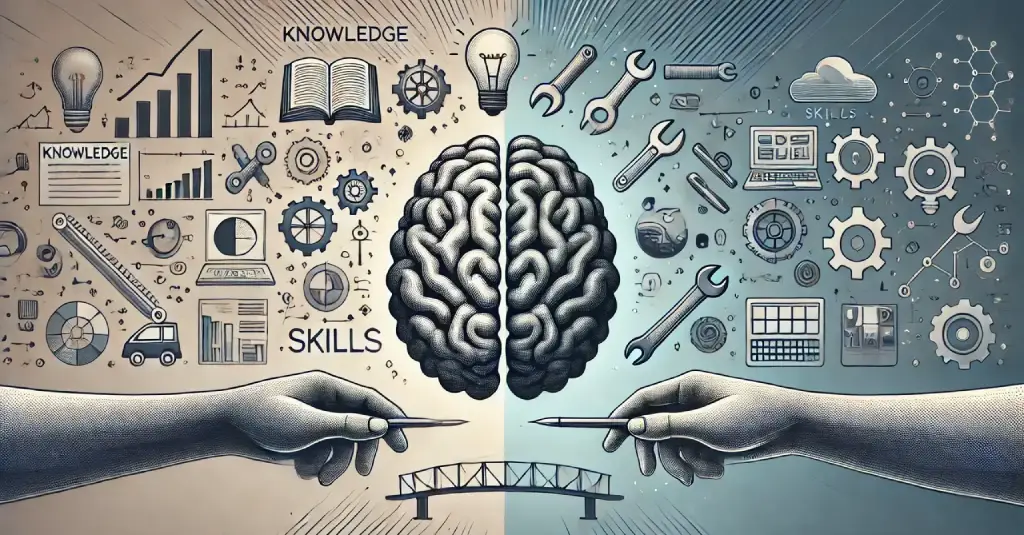
Knowledge and skills are closely related but distinct. Knowledge is the theoretical understanding of a subject – facts, concepts, and principles acquired through education or experience. Skills are the practical ability to apply that knowledge effectively in real situations. Both are essential for workforce performance, but they develop differently, are measured differently, and require different approaches to build at scale.
Knowledge vs skills at a glance
| Knowledge | Skills | |
|---|---|---|
| What it is | Theoretical understanding – facts, concepts, principles | Practical ability to perform tasks effectively |
| How it is acquired | Reading, training, observation, education | Practice, repetition, hands-on experience |
| How it is measured | Tests, exams, certifications, verbal assessments | Performance evaluations, demonstrations, practical tasks |
| Transferability | Easily transfers across contexts with little modification | Varies – soft skills transfer widely, hard skills are role-specific |
| Can it be taught? | Yes – the primary goal of most training programmes | Yes – through practice, coaching, and simulation |
| Example | Knowing the POSH Act 2013 requirements | Conducting a legally defensible ICC inquiry |
| LMS role | Courses, assessments, reading materials | Simulations, role-play, on-the-job practice tasks |
What is knowledge?
Knowledge is the information, facts, and principles that individuals acquire through education, experience, or observation. It forms the theoretical foundation of learning – providing the context to understand problems, interpret situations, and guide decisions. Knowledge can come from books, research, training programmes, mentors, or direct experience.
Explicit knowledge
Explicit knowledge is formal, documented, and easily transferable. It can be written down, codified, and shared – textbooks, training manuals, standard operating procedures, regulatory guidelines, product specifications. This is the type of knowledge most corporate training programmes deliver directly: an employee completes a course and acquires a defined body of information. Explicit knowledge is well-suited to e-learning, assessments, and LMS-based delivery.
Tacit knowledge
Tacit knowledge is informal, experiential, and difficult to articulate. It is the know-how that experienced employees carry in their heads – how a senior sales manager reads a client’s hesitation, how a veteran machine operator detects early signs of equipment failure, how an experienced compliance officer interprets regulatory ambiguity. Tacit knowledge cannot be transferred through a course. It requires mentoring, job shadowing, peer learning, and structured observation.
Procedural knowledge
Procedural knowledge is knowing how to do something – the sequence of steps involved in completing a task. It sits between explicit and tacit knowledge: it can be documented (as a SOP or process map), but true competence requires practice to internalise. A new bank teller may read the KYC procedure document (explicit) and know the steps (procedural), but only develops fluency through repeated practice at the counter.
Declarative knowledge
Declarative knowledge is knowing that something is true – facts, definitions, and information. Knowing that the POSH Act 2013 applies to all Indian organisations with 10 or more employees is declarative knowledge. It can be assessed with a quiz. It is necessary but not sufficient for competent performance – an employee can know the Act without being able to handle a complaint correctly.
What is skill?
Skill is the ability to perform tasks or actions effectively and efficiently through practice, training, or experience. Skills are developed through repetition and hands-on experience, allowing individuals to apply knowledge in practical situations. While knowledge is about understanding, skills are about doing.
Hard skills
Hard skills are technical, measurable abilities that are typically job-specific. They are acquired through formal education, certification, or structured training. Examples include coding, financial modelling, machine operation, GMP documentation, data analysis, and language proficiency. Hard skills are often required for specific roles and can be directly assessed through practical tests or certification exams.
Soft skills
Soft skills are interpersonal and behavioural abilities that determine how effectively a person interacts with others. They include communication, leadership, emotional intelligence, adaptability, and conflict resolution. While harder to quantify than hard skills, soft skills are critical determinants of performance in management, customer-facing, and collaborative roles. They are developed primarily through experience, feedback, and coaching – not through information-delivery courses.
Technical skills
Technical skills are specialised competencies within a specific domain or function – distinct from general hard skills in their depth and specificity. A financial analyst’s ability to build a DCF model is a technical skill. A pharmaceutical QA officer’s ability to conduct a root-cause analysis using the Ishikawa method is a technical skill. Technical skills typically require both foundational knowledge and sustained practice to develop to a professional standard.
Transferable skills
Transferable skills are competencies that apply across different roles, industries, or functions. Project management, written communication, data interpretation, and problem-solving are transferable skills that remain valuable regardless of where an employee works next. Building transferable skills is particularly important for organisations facing high attrition or rapid role evolution – these skills retain value even when specific technical requirements change.
Key differences between knowledge and skills
- Nature: Knowledge is theoretical and abstract – understanding concepts, principles, and facts. Skills are practical and hands-on – applying knowledge in real situations.
- Acquisition: Knowledge is acquired through reading, listening, and instruction. Skills are developed through practice, repetition, and feedback.
- Measurement: Knowledge is measured through tests and assessments that evaluate what a person knows. Skills are assessed through performance evaluations and practical tasks that test what a person can do.
- Dependence: Knowledge typically precedes skill development – you need to understand how something works before you can do it reliably. But skills can also be developed through practice before full theoretical mastery is achieved.
- Role in performance: Knowledge provides the foundation to diagnose problems and understand options. Skills enable the execution of solutions. A compliance officer needs knowledge of the regulation and skill in applying it under real-world conditions.
Knowledge vs skills vs competency vs talent: how they relate
These four terms are often conflated in L&D and HR conversations. Each describes something distinct, and confusing them leads to training programmes that address the wrong layer of the problem.
Knowledge is what you know – information, facts, principles. It is the input to performance, not performance itself. An employee can have perfect knowledge of a process and still be unable to execute it under pressure.
Skills are what you can do – the practical ability to apply knowledge in real situations. Skills are built through practice and are demonstrated through performance. Having knowledge does not automatically produce skill.
Competency is the combination of knowledge, skills, and behaviours required to perform a role to a defined standard. It is the performance benchmark – the level at which an employee is considered qualified for a task. A competency framework defines what “good” looks like for each role; training and assessment programmes are designed to close the gap between current and required competency.
Talent refers to natural, innate abilities – a predisposition toward excelling in certain areas. Talent determines the ceiling of potential. It can be identified, nurtured, and directed, but it cannot be created through training. The practical implication: training builds knowledge and skills; talent determines how far and how fast that development can go.
| Knowledge | Skills | Competency | Talent | |
|---|---|---|---|---|
| What it is | Information and understanding | Practical ability to act | Performance standard combining K+S+behaviour | Natural, innate aptitude |
| Can be trained? | Yes | Yes | Yes – by developing K+S | Can be nurtured, not created |
| Measured by | Tests and certifications | Performance tasks | Assessment against role framework | Aptitude and behavioural tests |
Workplace examples: knowledge and skills side by side
Abstract definitions become clearer with concrete workplace examples. The table below shows what knowledge and skill look like in real Indian enterprise roles.
| Role | Knowledge | Skill |
|---|---|---|
| BFSI Relationship Manager | RBI KYC guidelines and AML regulations | Conducting a compliant KYC verification with a real customer |
| Pharma QA Officer | WHO-GMP documentation requirements | Writing a deviation report that passes an audit inspection |
| Manufacturing Supervisor | Factories Act safety requirements | Identifying and correcting an unsafe work practice on the floor |
| L&D Manager | Adult learning theory and instructional design models | Designing a blended induction programme with measurable outcomes |
| Customer Service Rep | Refund policy and escalation procedures | Handling an angry customer complaint while following policy |
| Sales Representative | Product features and competitive positioning | Tailoring a pitch to a specific client’s objections in real time |
How to close the gap between knowledge and skills at work
Most corporate training has a knowledge-skill gap problem: programmes deliver information effectively but do not build the skills employees need to apply it. The result is employees who can pass a quiz but cannot perform the task under real conditions. Closing this gap requires deliberate design choices.
Assess capability, not completion
Completion rates measure whether training happened. Capability assessments measure whether it worked. Replace or supplement module completion tracking with practical assessments that test application – scenario-based questions, role-play evaluations, or on-the-job observation checklists. Employees who complete a module but fail the practical assessment have knowledge without skill – that gap needs a different intervention than another course.
Map competencies before courses
Before building or assigning training, define the competency standard for each role: what does a fully capable person in this role know and do? Then assess where employees currently stand against that standard. The gap between current state and required competency reveals whether the problem is knowledge (they do not know the information) or skill (they know it but cannot apply it). Assigning a knowledge course to close a skill gap is one of the most common and costly mistakes in L&D.
Space the practice
Skill development requires distributed practice over time, not a single intensive training event. Spaced repetition – revisiting content and practising application across multiple sessions – is consistently shown to produce more durable skill retention than massed practice. An LMS can implement this through learning paths that sequence knowledge delivery, then practice tasks, then assessment, spaced over days or weeks rather than compressed into a single module.
Move learning to the point of work
Skills are most durably built when practice happens as close to the real work context as possible. For frontline and field employees, this means mobile-first, scenario-based training delivered in the moment – not classroom sessions weeks before the skill is needed. For knowledge workers, it means embedding learning into workflows: a short refresher triggered when an employee is about to complete a compliance-sensitive task, not a standalone annual module divorced from the actual work.
Building employee knowledge and skills with an LMS
A Learning Management System bridges the gap between knowledge and skill development by addressing both layers systematically.
- Knowledge delivery: Courses, video lessons, reading materials, and assessments that transfer information to employees efficiently and at scale.
- Skills practice: Simulations, role-play scenarios, and practical assignments that convert knowledge into applied ability.
- Competency mapping: AI-powered skill gap analysis that identifies which employees have knowledge but lack practical skills – and vice versa – so training is targeted at the actual gap.
- Personalised paths: Role-based learning paths that sequence knowledge then skill development based on each employee’s current competency and role requirements.
- Point-of-work delivery: Mobile-first modules with offline access for frontline workers who need training close to where the work actually happens.
AlphaLearn’s employee training software includes skills management, competency frameworks, and AI-powered personalised learning paths – helping organisations develop both knowledge and skills systematically across every role and location. Start a free trial or book a demo.
FAQs – knowledge vs skills
Q: What is the difference between knowledge and skills?
A: Knowledge is the theoretical understanding of a subject – facts, concepts, and principles acquired through education or experience. Skills are the practical ability to apply that knowledge in real situations. You can have knowledge without skill (knowing the steps of a process but being unable to execute them under pressure) and, in some cases, skill without full theoretical knowledge (an experienced technician who can diagnose a fault intuitively).
Q: What is the difference between knowledge, skills, and competency?
A: Knowledge is what you know. Skills are what you can do. Competency is the combination of knowledge, skills, and behaviours required to perform a role to a defined standard. A competency framework sets the benchmark; training programmes close the gap between current and required competency.
Q: Can skills be taught, or are they innate?
A: Most skills can be taught and developed through practice, feedback, and experience. Natural talent may determine how quickly or how far a skill develops, but the skill itself is built through deliberate practice – not born. This is why skill development requires repeated practice opportunities, not just information delivery.
Q: How do you measure the difference between knowledge and skills in employees?
A: Knowledge is measured through tests, quizzes, and certification exams that assess what an employee knows. Skills are assessed through performance evaluations, practical demonstrations, scenario-based assessments, or on-the-job observation. A modern LMS like AlphaLearn supports both: knowledge assessments after each module, and skill-gap analysis that maps assessed performance against role competency standards.
Q: What is the knowledge-skill gap and how do you close it?
A: The knowledge-skill gap is the difference between what an employee knows (can pass a test on) and what they can do (can perform reliably in practice). It is closed by assessing capability rather than just completion, mapping competencies before assigning courses, using spaced practice rather than one-off training events, and delivering learning as close to the real work context as possible.
Priya Sharma
L&D Specialist
Priya has 9 years of experience designing corporate training programmes for BFSI and retail organisations across India. She specialises in onboarding, soft skills, and building learning cultures that actually stick.
Get Started
See AlphaLearn in action
500,000+ employees trained. ISO 27001:2022 certified.